
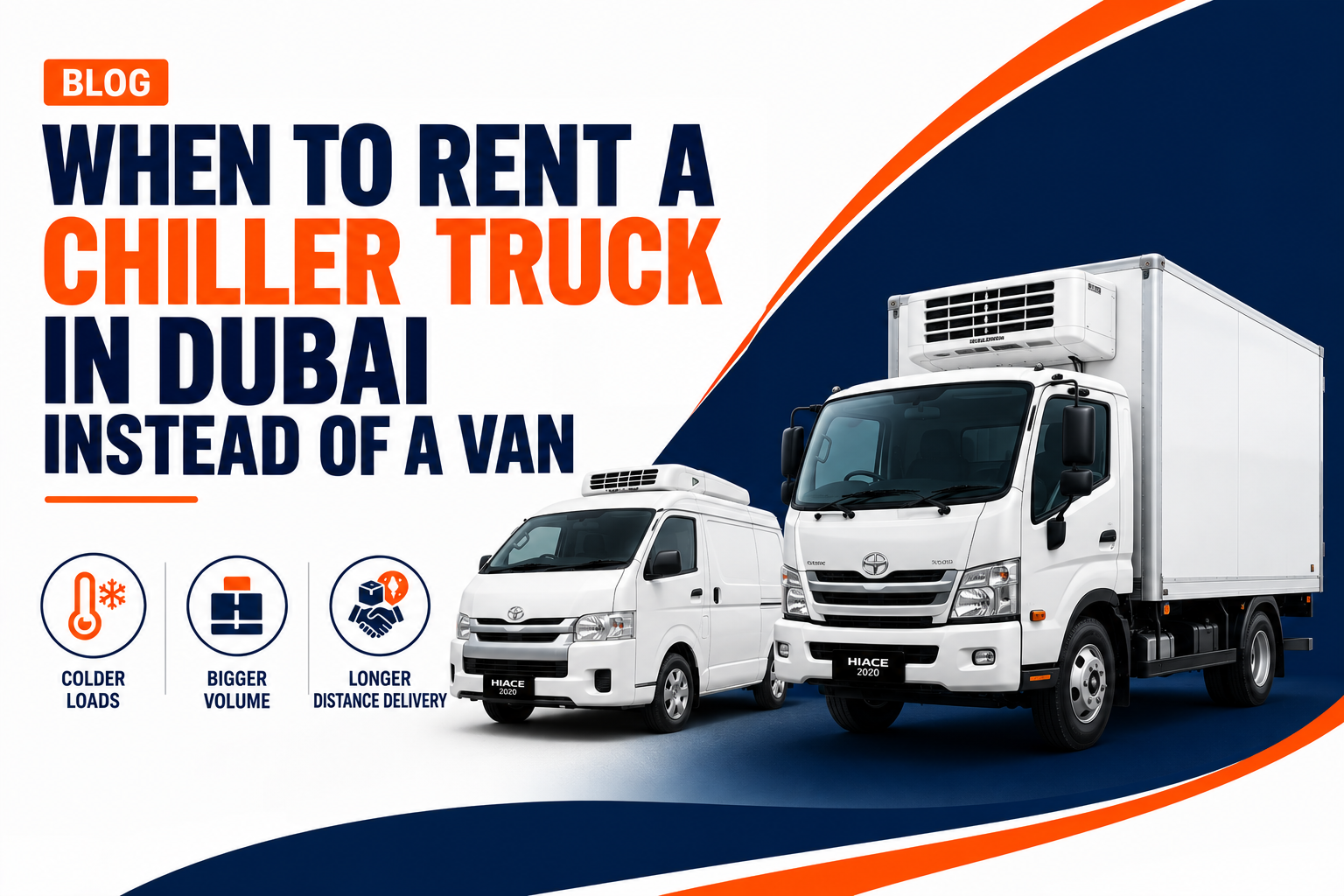
When to Rent a Chiller Truck in Dubai Instead of a Van
Most businesses in Dubai start their cold chain operations with a chiller van. It makes sense: vans are affordable, manoeuvrable in city traffic, and carry enough for a typical multi-stop restaurant or retail delivery run. But at some point, a growing business hits a ceiling where the van is no longer enough. Deliveries take too long because the van has to make two trips instead of one. Cargo gets left behind because it does not fit. Wholesale clients want full pallets, not partial loads.
That moment is when the conversation shifts from chiller van to chiller truck. But the jump from van to truck is not just about carrying more cargo. The vehicle, the route type, the operating cost, the driver skill requirements, and even the loading infrastructure all change. This guide helps you determine whether your operation in Dubai has reached the point where a chiller truck is the right move, or whether a van (or even two vans) is still the smarter choice.
Quick Answer: A chiller truck in Dubai makes sense when your cargo regularly exceeds 1.5 tonnes per trip, your route involves fewer than 5 stops per run, your deliveries go to locations with proper loading docks, or you need to move full pallets rather than loose cartons. If your cargo is under 1.5 tonnes, your route has 8 or more stops, and your deliveries go to locations with narrow access (restaurant back doors, small retail shops), a chiller van is still the better vehicle.
What Counts as a Chiller Truck in Dubai
In the UAE rental market, a chiller truck is any refrigerated vehicle with a payload capacity above 3 tonnes. Below that, it is classified as a van. The practical dividing line sits around the 1.5 to 3 tonne range, where larger vans and small trucks overlap.
Chiller trucks available for rent in Dubai typically fall into three size brackets:
| Truck Class | Payload | Temp Range | Typical Use in Dubai |
| Light chiller truck | 3 to 4 tonnes | 0 to +8 C | Medium wholesale, hotel daily supply, supermarket restocking single store |
| Medium chiller truck | 5 to 7 tonnes | 0 to +8 C | Bulk wholesale, multi-store supermarket restocking, industrial catering |
| Heavy chiller truck | 7 to 10 tonnes | 0 to +8 C | Large wholesale distribution, warehouse-to-warehouse transfers, cross-emirate bulk |
All three operate in the 0 to 8 degree chiller range. For sub-zero requirements (frozen food, ice cream), the equivalent vehicles are called freezer trucks. For adjustable-temperature trucks with standalone refrigeration units, see our guide on reefer trucks.
Five Signs You Have Outgrown a Chiller Van
The transition from van to truck is not always obvious. Many businesses stick with vans longer than they should because switching feels like a big decision. Here are the operational signals that indicate a chiller truck is the more efficient choice:
Sign 1: Your Van Is Making Two Trips for One Route
A chiller van carries 1 to 1.5 tonnes. If your daily cargo load has grown to 2 or 3 tonnes, the van has to make two trips to complete a route that a truck could handle in one. The second trip doubles your vehicle time, fuel consumption, and driver hours. It also means the second batch of cargo sits in your warehouse or cold room waiting for the van to return, which adds cold chain risk and delays your delivery schedule.
If you find yourself splitting loads more than twice a week, a single chiller truck will almost certainly be cheaper and faster than running the same van twice.
Sign 2: Your Clients Want Full Pallet Deliveries
A standard chiller van cannot accept a full Euro pallet through its rear doors. The internal height and width restrict pallet handling to loose cartons, crates, and smaller containers. When your wholesale clients start requesting full-pallet deliveries, or when your own warehouse operates on palletised inventory, the van becomes a bottleneck.
Chiller trucks have wider rear openings, taller cargo areas, and the floor strength to handle pallet jacks and even small forklifts for loading. Some trucks come with tail lifts (hydraulic rear platforms) that allow pallets to be loaded from ground level without a loading dock, which is useful for deliveries to locations without raised dock facilities.
Sign 3: Your Route Has Fewer Than 5 Stops
The chiller van’s biggest advantage is manoeuvrability on multi-stop routes: it fits in narrow service lanes, parks quickly, and the driver can unload cartons by hand without special equipment. That advantage disappears when your route has only 2 or 3 stops. If you are loading 3 tonnes of dairy at a cold store and delivering it to two hotel receiving docks, you do not need urban agility. You need cargo capacity.
As a general rule: 8 or more stops per route favours a van. Fewer than 5 stops with heavy loads favours a truck.
Sign 4: Your Delivery Locations Have Loading Docks
Hotels, supermarkets, food manufacturing facilities, and cold storage warehouses have raised loading docks designed for trucks. These docks are at truck bed height (approximately 1.2 metres), not van floor height. Delivering to a dock with a van often means unloading by hand down a ramp or steps, which is slow and increases cargo handling damage risk.
If your primary delivery locations are dock-equipped (as most B2B wholesale clients are), a chiller truck aligns with their receiving infrastructure and enables faster, safer unloading.
Sign 5: You Are Paying for Two Vans When One Truck Would Do
Running two chiller vans simultaneously to cover your volume means two vehicles, two drivers (if renting with driver), twice the maintenance, and twice the insurance. A single chiller truck carrying the combined load of both vans with one driver is often more cost-effective, even though the truck’s daily rental rate is higher than a single van’s rate.
The maths works in the truck’s favour when the combined daily cost of two vans (rental plus fuel plus driver) exceeds the daily cost of one truck (rental plus fuel plus driver). Ask your rental provider for a side-by-side quote to compare.
When to Stick With a Van Instead
A chiller truck is not the answer to every growth problem. In several common scenarios, a van remains the better vehicle even for businesses that have scaled up:
Multi-Stop City Routes With 8 or More Drops
A 10-stop restaurant supply route across Deira, Al Rigga, and Al Nahda requires a vehicle that can park on narrow side streets, navigate congested old-town lanes, and make each stop in under 5 minutes. A 7-tonne chiller truck physically cannot access many of these locations. In these situations, a Hiace chiller van is the right tool regardless of cargo volume.
Deliveries to Locations Without Loading Docks
Small restaurants, independent grocers, flower shops, and pharmacies typically receive deliveries at their front door or a small rear entrance. There is no raised dock, no forklift, and no space for a large vehicle. The driver parks the van as close as possible and carries cartons in by hand. A truck makes this process harder, not easier.
Split Routes Across Different Temperature Requirements
If you deliver both chilled and frozen products to different clients on the same route, running one chiller van and one freezer van may be more practical than trying to find a single dual-temperature truck, which is a specialist vehicle that is harder to source and more expensive to rent. For more on dual-temperature options, see our chiller van vs freezer van guide.
Short-Term or Variable Demand
If your volume fluctuates week to week, committing to a larger truck means paying for capacity you do not always use. Two vans give you the flexibility to deploy one on light days and both on heavy days. A single truck is all or nothing. For businesses with variable demand, flexible van rental terms often make more sense than a fixed truck contract.
Chiller Truck vs Chiller Van: Side-by-Side Comparison
| Factor | Chiller Van | Chiller Truck |
| Payload | 1 to 1.5 tonnes | 3 to 10 tonnes |
| Best stop count | 8 to 15 stops per route | 1 to 5 stops per route |
| Urban manoeuvrability | Excellent (fits narrow lanes, small parking) | Limited (wider turning, needs dock or open space) |
| Pallet handling | No (manual carton loading only) | Yes (pallet jack, optional tail lift) |
| Loading dock compatibility | Low (van floor height does not match docks) | High (truck bed height matches standard docks) |
| Fuel consumption | Lower (8 to 12 L/100km) | Higher (15 to 25 L/100km depending on size) |
| Rental cost | Lower daily rate | Higher daily rate but potentially cheaper than 2 vans |
| Driver licence | Standard UAE driving licence (light vehicle) | Heavy vehicle licence required for trucks above 3.5 tonnes |
| Delivery speed per stop | Fast (park, unload by hand, leave) | Slower (dock alignment, pallet unload, documentation) |
| Best for | Restaurants, pharmacies, florists, bakeries, retail shops | Hotels, supermarkets, wholesale, cold stores, factories |
The Hybrid Approach: Van for Last Mile, Truck for Wholesale
Many businesses in Dubai do not choose between a van and a truck. They use both. The chiller truck handles the high-volume first leg: loading 5 tonnes at the cold store or factory and delivering full pallets to 2 or 3 wholesale clients or hotel receiving docks. The chiller van handles the multi-stop last mile: taking 1 tonne from the distribution point and delivering cartons to 10 individual restaurants, grocers, or pharmacies.
This split makes operational sense because each vehicle is used for what it does best. The truck moves volume efficiently. The van moves quickly through congested city streets. Trying to do both jobs with one vehicle type means compromising on either capacity or agility.
For a complete overview of all vehicle options and where each fits, see our all types of refrigerated vehicles guide.
What Affects the Cost of Renting a Chiller Truck in Dubai
A chiller truck costs more to rent per day than a chiller van. But the per-tonne or per-delivery cost may be lower when you factor in the efficiency gains. The main cost factors are:
- Truck size: A 3-tonne chiller truck costs less than a 7-tonne or 10-tonne truck. Rent the size you actually need, not the biggest available
- Rental duration: Monthly rates are 25 to 40 percent lower per day than daily rates. If you need a truck regularly, a monthly contract is significantly cheaper
- Driver: Trucks above 3.5 tonnes require a driver with a heavy vehicle licence. If you do not have one on your team, renting with a driver is the practical option. This adds to the daily rate
- Fuel: Chiller trucks consume 15 to 25 litres per 100 km depending on size and load, roughly double a chiller van. Factor fuel into your total cost comparison
- Route distance: A truck on a short 30 km wholesale route costs less in fuel than the same truck on a 150 km cross-emirate run. Match the vehicle to the actual distance
For the full pricing breakdown, see our guide on chiller van rental pricing in the UAE.
Dubai Zones Where Chiller Trucks Are Most Common
Chiller trucks operate primarily in Dubai’s industrial and wholesale zones where loading docks, wide roads, and bulk-handling infrastructure support larger vehicles:
- Al Quoz: Outbound wholesale distribution from food manufacturers and cold stores to city clients
- Ras Al Khor: Morning wholesale dispatch of fresh produce, seafood, and meat from the Waterfront Market
- JAFZA and Jebel Ali: Port-to-warehouse container transfers and outbound distribution from import warehouses
- DIP: FMCG and beverage manufacturer outbound to supermarkets and retail chains
- Dubai South: Growing logistics hub for air freight cold chain and secondary distribution
In contrast, chiller vans dominate the city-centre zones: Deira, Bur Dubai, Business Bay, Dubai Marina, JLT, and the hotel corridors. For a full zone-by-zone breakdown of which vehicle works where, see our Dubai industrial zones cold chain guide.
Frequently Asked Questions
What is a chiller truck?
A chiller truck is a medium to large truck with an insulated cargo body and refrigeration unit maintaining 0 to 8 degrees Celsius. Payload capacity ranges from 3 to 10 tonnes. It is the larger counterpart to the chiller van, used for wholesale, hotel supply, and supermarket restocking where volumes exceed what a van can carry.
When should I switch from a chiller van to a chiller truck?
When your cargo regularly exceeds 1.5 tonnes per trip, you are making two van trips for a route a truck could cover in one, your clients want full pallet deliveries, or the combined cost of two vans exceeds one truck. Any of these signals indicate the truck is more efficient.
Can I use a chiller truck for city restaurant deliveries?
It depends on the restaurants. Hotels and large restaurants with loading docks work well with trucks. Small restaurants in old Dubai (Deira, Bur Dubai, Al Rigga) with narrow service lane access are better served by a van. Many operators use trucks for wholesale legs and vans for the last-mile multi-stop portion.
What is the difference between a chiller truck and a chiller van?
Payload is the primary difference: vans carry 1 to 1.5 tonnes, trucks carry 3 to 10 tonnes. Trucks also accept full pallets, align with standard loading docks, and have higher fuel consumption. Vans are faster on multi-stop city routes. Trucks are more efficient for low-stop bulk delivery.
What is the capacity of a refrigerated van?
A standard chiller van (Toyota Hiace class) carries 1,000 to 1,500 kg depending on insulation type. The cargo bay is approximately 2.8 metres long and 1.5 metres high (standard roof) or 1.8 metres (high roof). For loads exceeding 1.5 tonnes, a chiller truck is the correct step up.
Do I need a special licence to drive a chiller truck?
In the UAE, trucks above 3.5 tonnes gross vehicle weight require a heavy vehicle driving licence (category 5 or higher depending on truck size). This is different from the standard light vehicle licence used for chiller vans. If your team does not hold the correct licence, renting with a trained driver is the practical solution.
Is it cheaper to rent two vans or one truck?
Calculate the combined cost of two vans (two rental fees, two fuel costs, two drivers if applicable) against one truck (one rental fee, one fuel cost, one driver). In most scenarios where two vans are running the same route, a single truck is cheaper. But if the two vans serve different routes in different parts of the city, running both vans is more practical even if it costs more, because a single truck cannot be in two places at once.
What is a box truck?
A box truck is any truck with a rectangular enclosed cargo body. Not all box trucks are refrigerated. A chiller truck is a box truck that has been insulated and fitted with a refrigeration unit to maintain controlled temperatures. In the UAE rental market, “chiller truck” and “refrigerated box truck” are used interchangeably.
Not sure whether you need a van or a truck?
Contact Al Sahara at +971 52 373 7016, WhatsApp, or via our contact page. Tell us your cargo type, weight, and route, and our team will recommend the right vehicle.

Abdul Basit
With over a decade of specialized experience in UAE's temperature-controlled logistics sector, I oversee critical cold-chain operations and compliance standards at Al Sahara. My expertise bridges the gap between stringent municipal HACCP regulations and practical, high-efficiency transport solutions for the F&B and pharmaceutical industries. I am deeply committed to sharing actionable insights on fleet management, GDP-compliant medical transport, and mitigating extreme-weather supply chain risks. Through these articles, I aim to equip local businesses with the knowledge needed to scale their operations securely and cost-effectively without compromising product integrity.