Food & BeverageCold Chain Transport UAE
Refrigerated transport for food and beverage businesses across the UAE: chilled cargo at 0°C to +8°C in chiller vans, frozen at -18°C to -25°C in freezer vans, and both on one route in dual-compartment vans — with continuous temperature logging on every trip.
-25°C to +8°C
Temperature Range
1 to 10 Tons
Fleet
HACCP-Compliant
Compliance
Retail · HoReCa · FMCG
Clients
Why Choose Al Sahara?
Multi-Drop Routes
Restaurant, café and retail routes with many short stops, planned so the last item loaded is the first delivered.
Night & Early Windows
Off-peak delivery for retail restocking, when roads are quieter and ambient temperatures lower.
Chilled, Frozen or Both
Chiller, freezer or dual-compartment bodies, matched to what the cargo needs.
Temperature Records
Continuous digital logging on every trip, printable for your HACCP file.
Pre-Cooled Dispatch
Vans arrive pulled down to your set point, not warming up at your door.
Driver or Self-Drive
A trained cold-chain driver, or self-drive against a UAE licence and deposit.
Quick Answers
The short version of everything customers ask us about food and beverage cold chain transport in the UAE.
- Which vehicle for dairy, produce or chilled meat?
- A chiller van, holding 0°C to +8°C. Set it to the product: most dairy and chilled meat travel at the cold end of that band.
- Which vehicle for frozen food?
- A freezer van, holding -18°C to -25°C. A chiller unit stops around 0°C, so it cannot keep frozen stock frozen.
- Chilled and frozen on one route?
- A dual-compartment refrigerated van: an insulated bulkhead splits the body into two zones with separate set points.
- Palletised supermarket orders?
- A refrigerated truck with a tail lift. Vans are hand-loaded and cannot take forklifted pallets.
- Multi-drop routes?
- Yes. Restaurant, café and retail routes with many short stops are the most common work for our vans.
- Night and early-morning delivery?
- Yes. Off-peak windows suit retail restocking and avoid daytime traffic and heat.
- Temperature records?
- Continuous digital logging on every trip, with a printable record for your HACCP file or a receiving dock.
- Food transport approval?
- HACCP-compliant refrigerated fleet with Dubai Municipality approved food transport vehicles.
Which Vehicle for Which Food Cargo
Food transport goes wrong in one of two ways: the cargo travels in the wrong temperature band, or it travels in a vehicle that fills before the order does. Both are decided before the booking, by the product and how it is packed. Start from the cargo, not from the vehicle.
| Cargo | Typical set point | Vehicle |
|---|---|---|
| Milk, yoghurt, cheese | 0°C to +5°C | Chiller van |
| Fresh meat and poultry | 0°C to +4°C | Chiller van |
| Fresh fish and seafood | 0°C to +2°C, often on ice | Chiller van |
| Fruit and vegetables | +2°C to +8°C (see note) | Chiller van |
| Bakery and pastry | 0°C to +8°C | High roof chiller van |
| Beverages and juices | 0°C to +8°C | Standard chiller van |
| Frozen meat, fish, ready meals | -18°C or colder | Freezer van |
| Ice cream | -20°C or colder | Freezer van |
| Chilled and frozen on one route | Two zones | Dual-compartment refrigerated van |
| Palletised orders, ~3 tons and up | Per product | Refrigerated truck |
Typical set points only — always follow your product specification. Some produce, such as bananas and other tropical fruit, is damaged by cold and needs a warmer set point than most chilled loads; tell us at booking.
Supermarket and Distribution Centre Deliveries
Large retailers receive into distribution centres that run to a timetable. Deliveries are usually booked into an appointment slot, and the receiving team checks product temperature at the gate before accepting the load. Arrive late and the slot is gone; arrive warm and the load can be turned away with the stock still on board.
Two things protect a delivery at that gate. The first is a vehicle that was cold before the cargo went in: we dispatch pre-cooled, so the first pallet does not spend the opening minutes of the journey pulling heat out of a warm box. The second is the temperature record — logged continuously from collection, so the receiving team can see the whole journey rather than a single reading at the door.
Orders that arrive on pallets belong on a refrigerated truck with a tail lift. Smaller replenishment drops to individual stores are van work.
Multi-Drop Routes for Restaurants and Retail
A restaurant or café round might mean twelve to twenty stops in a shift. Every stop opens the doors, and every opening in UAE heat lets cold air out of the box. The vehicle is specified for that, but how the route is run decides more than the vehicle does.
Load in reverse drop order, so the first delivery sits at the back doors. Keep the doors closed between stops rather than propped. Leave space above the load and keep it off the front bulkhead, so cold air can circulate back to the unit. A chiller van run this way holds temperature across a long day; one stacked to the roof does not.
For city work in Dubai, Abu Dhabi and Sharjah, vans are staged locally rather than driven across from another emirate on the morning of the route.
Night and Early-Morning Deliveries
Retail restocking often happens before stores open. Off-peak windows bring three advantages for chilled food: quieter roads, so drops run to time; less contested unloading bays; and a lower ambient temperature, so each door opening costs the unit less to recover. Tell us the window at booking and the route is planned to it.
Frozen Food Needs a Freezer Van
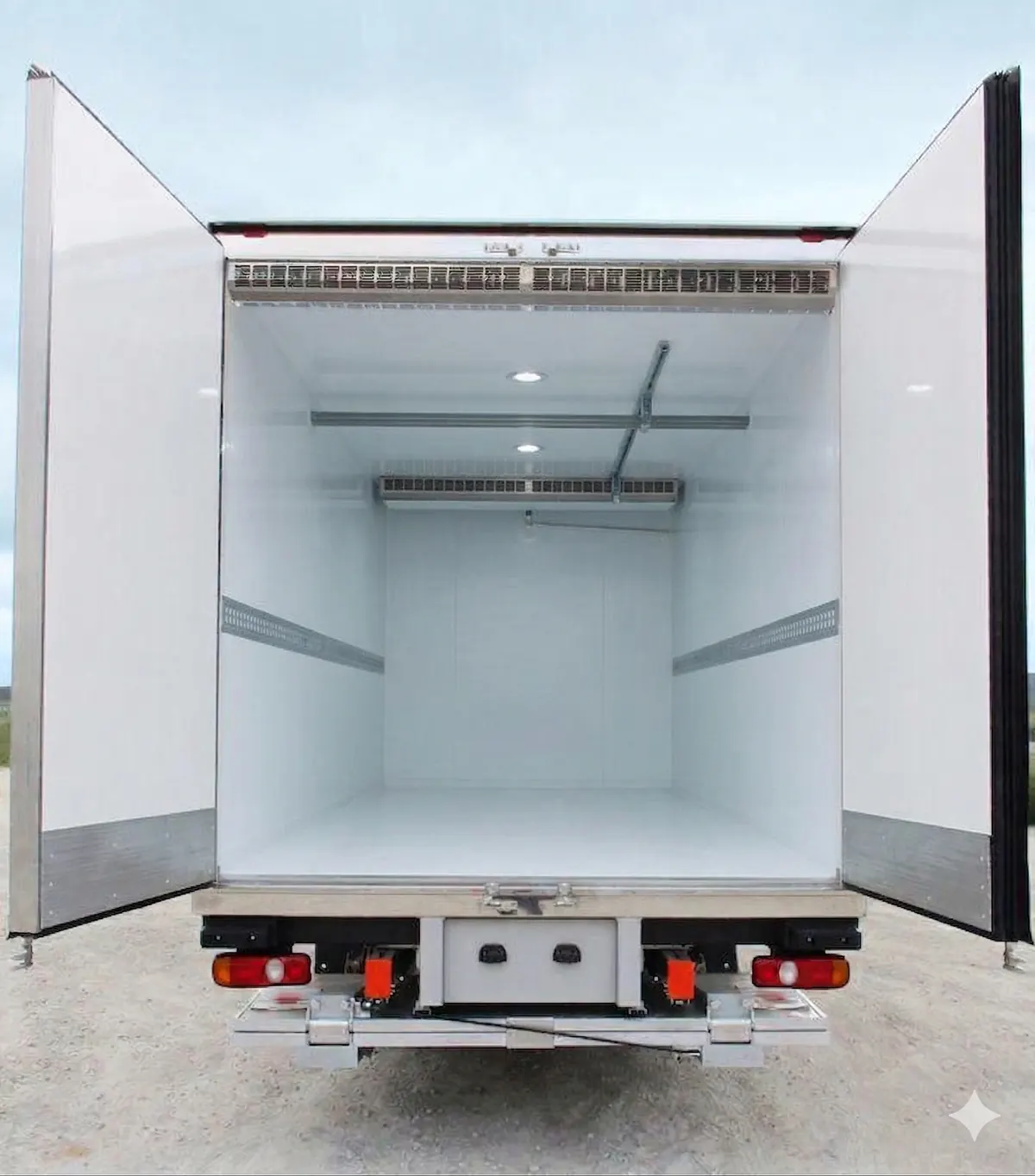
A chiller unit stops around 0°C. It will not keep frozen stock frozen, and frozen food that softens in transit cannot be re-frozen and sold. Frozen meat, fish, ready meals and ice cream travel in a freezer van holding -18°C to -25°C, with heavier insulation than a chiller body.
When a route carries both — a wholesaler supplying chilled dairy and frozen desserts to the same customers — a dual-compartment refrigerated van splits the body into two zones, so neither load has to compromise.
Dense Cargo, Bulky Cargo and the Right Body
Beverages, dairy and meat are dense: a standard-roof van reaches its weight limit with space to spare. Bakery trays, packaged produce and empty crates are the opposite — they fill the body long before the payload is used, and a high roof adds a full stacking layer on the same footprint and licence.
The quick test is to divide the weight of a typical load by the space it fills. Below roughly 250 kg per cubic metre, choose the taller body. The full method is in our guides to chiller van internal dimensions and high roof or standard.
Before You Accept a Van
Five minutes at handover catches most of what goes wrong in food transport: a box that is not yet cold, a tired door seal, blocked floor channels. Our refrigerated van handover checklist covers what to check, whoever you hire from.
Vehicles for Food Distribution
- Toyota Hiace chiller van (1-ton)
The standard van for chilled multi-drop routes at 0°C to +8°C.
- 1-ton freezer van
Frozen food and ice cream at -18°C to -25°C.
- High roof chiller van
Bakery, produce and other bulky, light loads.
- Refrigerated van specs
Chiller, freezer and dual-compartment configurations.
Compliance & Standards
- HACCP-compliant refrigerated fleet
- Dubai Municipality approved food transport vehicles
- GDP-aligned handling for pharmaceutical cold chain
- Continuous digital temperature logging on every trip
- GPS-tracked vehicles with 24/7 dispatch
- Depots in Dubai, Abu Dhabi and Sharjah, serving all seven Emirates