

How Does a Chiller Van Work? Refrigeration Systems Explained
Every chiller van on the roads of Dubai, Abu Dhabi, and Sharjah relies on the same core engineering: a mechanical refrigeration cycle that removes heat from the cargo area and expels it into the outside air. But the way this cycle performs in the UAE, where ambient temperatures regularly exceed 45 degrees Celsius, is different from how it performs in milder climates. The refrigeration unit works harder, consumes more fuel, and faces failure risks that do not exist in cooler countries.
This guide explains exactly how a chiller van works, what components make up the refrigeration system, which refrigerant gases are used, how the system behaves during multi-stop delivery runs, what noise levels to expect, and whether you can convert a standard van into a refrigerated one. If you operate or plan to rent a chiller van, understanding the refrigeration system helps you make better decisions about vehicle selection, loading procedures, and route planning.
Quick Answer: A chiller van works by using a mechanical vapour-compression refrigeration cycle. A compressor (driven by the vehicle engine or a standalone motor) circulates refrigerant gas through a closed loop. The refrigerant absorbs heat from the cargo area through the evaporator, then releases that heat outside through the condenser. This cycle repeats continuously to maintain the set temperature, typically 0 to 8 degrees Celsius for chilled goods or minus 18 to minus 25 degrees for frozen goods.
The Refrigeration Cycle Inside a Chiller Van
The refrigeration system in a chiller van uses the same vapour-compression cycle found in household refrigerators, air conditioning systems, and industrial cold rooms. The difference is scale, power source, and the extreme conditions the system must handle in a moving vehicle operating in desert heat.
The cycle has four stages that repeat continuously while the unit is running:
Stage 1: Compression
The compressor is the heart of the refrigeration system. It takes low-pressure refrigerant gas from the evaporator and compresses it into high-pressure, high-temperature gas. In a chiller van, the compressor is typically belt-driven from the vehicle engine (in engine-dependent systems) or powered by a separate diesel or electric motor (in standalone systems). The compressor must run continuously during transit to maintain the set temperature inside the cargo area.
Stage 2: Condensation
The high-pressure hot gas flows through the condenser, which is mounted on the outside of the vehicle, usually on the roof alongside the main unit housing. The condenser is a heat exchanger with metal fins and a fan. As outside air passes over the condenser fins, the refrigerant releases its heat to the atmosphere and transforms from a gas into a high-pressure liquid. In the UAE, this stage is the most demanding because the outside air temperature can reach 50 degrees Celsius, which reduces the temperature difference between the refrigerant and the air, making heat rejection less efficient.
Stage 3: Expansion
The high-pressure liquid refrigerant passes through an expansion valve (also called a metering device). This valve creates a sudden pressure drop, which causes the refrigerant to partially evaporate and cool down dramatically. The cold, low-pressure refrigerant then enters the evaporator inside the cargo area.
Stage 4: Evaporation
The cold refrigerant flows through the evaporator coil mounted inside the cargo area (typically at the front wall, near the cab). A fan blows air from the cargo area across the evaporator coil. The refrigerant absorbs heat from this air, cooling the cargo area. The refrigerant evaporates fully back into a gas and returns to the compressor to start the cycle again.
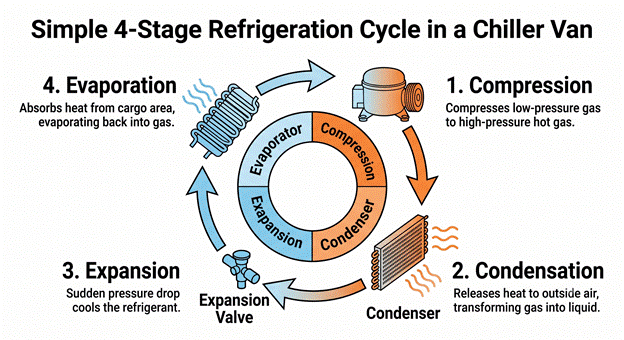
This cycle runs continuously. The thermostat monitors the cargo area temperature and signals the compressor to adjust its output to maintain the set point. When the cargo area reaches the target temperature, some systems reduce compressor speed rather than stopping entirely, which provides more stable temperature control.
Which Gas Is Used in a Chiller Van?
Quick Answer: Modern chiller vans in the UAE use R-134a or R-404A refrigerant gas. R-134a is standard for chiller-temperature applications (0 to 8 degrees). R-404A is used for freezer applications requiring temperatures below minus 18 degrees. Older systems may still use R-22, but this gas is being phased out under the Montreal Protocol due to its ozone depletion potential.
The refrigerant gas is the working fluid that carries heat from inside the cargo area to the outside. It is a synthetic chemical compound designed to change between liquid and gas states at specific temperatures and pressures. The two most common refrigerants in UAE chiller vans are:
| Refrigerant | Temp Range | Application | Status |
| R-134a | 0 to +8 degrees C | Chiller vans for fresh food, dairy, pharma, flowers | Current standard, widely available |
| R-404A | -18 to -40 degrees C | Freezer vans for ice cream, frozen meat, frozen food | Current standard for sub-zero |
| R-22 (legacy) | Various | Older systems only | Being phased out, ozone-depleting |
| R-452A | -18 to -40 degrees C | Next-gen replacement for R-404A | Emerging in newer units |
The refrigerant is sealed inside the system and should not need topping up under normal operation. If a chiller van loses cooling performance, it usually indicates a refrigerant leak, which requires professional repair. When renting a chiller van from Al Sahara, all refrigerant systems are checked and certified before dispatch.
Engine-Driven vs Standalone Refrigeration Units
The power source for the refrigeration compressor determines how the chiller van behaves during loading, idling, and engine-off situations. There are two configurations in the UAE market:
Engine-Driven (Direct Drive) Systems
The compressor is belt-driven from the vehicle engine. When the engine runs, the refrigeration runs. When the engine is off, the refrigeration stops. This is the most common configuration for chiller vans because it is simpler, lighter, and less expensive. The trade-off is that during extended loading at a warehouse dock (engine off), the cargo area gradually warms up.
In the UAE, this matters during summer. A chiller van parked at a loading bay with the engine off in 48-degree ambient heat will see its cargo temperature rise by 1 to 2 degrees every 15 to 20 minutes, depending on insulation quality and how often the rear doors are opened.
Standalone (Independent) Systems
The compressor is powered by a separate small diesel engine or an electric motor with its own power source. The refrigeration unit operates independently of the vehicle engine. This means the cargo area stays cold even when the vehicle is parked with the engine off.
Standalone systems are standard on larger reefer trucks and freezer trucks but less common on Hiace-class vans due to the additional weight and cost. Some newer van-class units offer electric standby mode, which connects to a mains power supply at the depot to keep the cargo cold overnight without running the vehicle engine.
Insulation: The Other Half of How a Chiller Van Works
The refrigeration unit removes heat, but the insulation prevents heat from getting in. Without proper insulation, no refrigeration unit can maintain target temperature in UAE summer conditions. The insulation and the refrigeration unit work as a system, and one cannot compensate for failure in the other.
Chiller vans in the UAE are typically insulated with rigid Styrofoam (expanded polystyrene) or polyurethane foam panels bonded to the interior walls, ceiling, and floor of the cargo area:
- 50mm Styrofoam: Standard for chiller applications (0 to 8 degrees). Adequate for most fresh food, dairy, pharmaceutical, and flower delivery routes in the UAE.
- 75mm polyurethane: Standard for freezer applications (minus 18 to minus 25 degrees). Thicker insulation reduces heat ingress but also reduces internal cargo volume and payload capacity.
The cargo door is the weakest point in the insulation envelope. Every time the rear doors open during a delivery stop, warm outside air floods in. In the UAE, opening the doors for 60 seconds at a loading dock in summer can raise the cargo temperature by 2 to 4 degrees. This is why experienced drivers open and close doors as quickly as possible and why multi-stop delivery routes must be planned with temperature recovery time between stops.
How Does Temperature Control Work During a Multi-Stop Delivery?
A single delivery run in Dubai might involve 8 to 15 stops across areas like Al Quoz, Deira, Business Bay, and JLT. At each stop, the driver opens the rear doors to unload cargo. Each door opening causes a temperature spike inside the cargo area. The refrigeration unit then works to pull the temperature back down before the next stop.
The cycle looks like this:
- Van departs the depot or warehouse at the set temperature (for example, 4 degrees Celsius)
- Driver arrives at stop 1, opens doors for 2 to 3 minutes to unload. Internal temperature rises to 7 or 8 degrees
- Driver closes doors, begins driving to stop 2. Refrigeration unit pulls temperature back to 4 degrees within 5 to 10 minutes
- Process repeats at each stop
By the 10th or 12th stop, the cumulative heat ingress and door openings can strain the system, particularly in summer. This is why route planning matters. Grouping stops by proximity and minimising door-open time at each stop directly affects whether the cargo stays within the required temperature band throughout the run.
For a full comparison of how different vehicle types handle these demands, see our complete vehicle reference guide.
Are Refrigerated Vans Noisy?
Quick Answer: Yes, refrigerated vans are noisier than standard vans due to the compressor and condenser fan on the refrigeration unit. Engine-driven systems add a constant mechanical hum. Standalone diesel units are louder due to the separate engine. Noise levels typically range from 65 to 75 dB at 1 metre from the unit, comparable to a loud conversation or busy traffic. Newer Carrier and Thermo King units designed for urban delivery are quieter than older models.
The primary noise sources are the compressor (mechanical cycling), the condenser fan (blowing air across the heat exchanger), and the evaporator fan (circulating cold air inside the cargo area). During loading when the engine is running and the unit is at full cooling capacity, the noise is at its peak.
For early-morning hotel and restaurant deliveries in residential areas of Dubai, Abu Dhabi, or Sharjah, newer compact units like the Carrier Citimax series are specifically designed for lower noise output during urban delivery.
Can You Convert a Standard Van into a Chiller Van?
Quick Answer: Yes, you can convert a standard van into a chiller van. A typical conversion involves lining the cargo area with insulation panels, installing a roof-mounted refrigeration unit, sealing all joints and door gaps, and installing a digital thermostat with a cab-mounted display. A professional conversion on a Toyota Hiace or similar van in the UAE typically takes 5 to 10 working days.
However, converting a van is not always the best business decision. The conversion cost, ongoing maintenance of the refrigeration unit, and the reduced payload (due to insulation weight) must be weighed against the flexibility of renting a purpose-built chiller van that comes maintained, insured, and ready to operate.
Conversion also does not automatically make the vehicle compliant with Dubai Municipality or HACCP food transport requirements. Compliance depends on the quality of the conversion, the insulation standard, the calibration of the temperature monitoring system, and the cleaning and hygiene procedures applied to the cargo area.
Is a Chiller the Same as a Compressor?
Quick Answer: No. The compressor is one component inside the chiller system. The compressor pressurises the refrigerant gas, which is one stage of the four-stage refrigeration cycle. A chiller van is the complete system: compressor, condenser, expansion valve, evaporator, insulated cargo body, thermostat, and controls all working together to maintain a set temperature.
What Is a Fridge Van?
Quick Answer: A fridge van is simply another name for a chiller van or refrigerated van. In the UAE market, the terms chiller van, fridge van, refrigerated van, and cold van are used interchangeably. They all refer to a van with an insulated cargo area and a refrigeration unit maintaining a controlled temperature for perishable goods during transport.
The term “fridge van” is more common in everyday conversation, while “chiller van” is the standard industry term used in the UAE rental market. “Refrigerated van” is the formal term used in regulatory and compliance documentation. For the full list of vehicle types and their correct names, see our complete vehicle type guide.
Chiller Van Refrigeration Brands Used in the UAE
Two brands dominate the UAE chiller van refrigeration market:
- Carrier Transicold: Global leader in transport refrigeration. Their Citimax and Pulsor series are widely fitted on van-class vehicles in the UAE. Known for compact design, lower noise levels, and strong dealer support across Dubai and Abu Dhabi.
- Thermo King: The other major brand. Their V-200 MAX and V-300 MAX series are common on Hiace-class vehicles. Known for robust performance in extreme heat and availability of electric standby on some models.
Both brands have service centres across the UAE, which is critical for rental fleet operators who need rapid maintenance response. Al Sahara’s fleet uses both Carrier and Thermo King units, selected based on vehicle configuration and client requirements.
To see the specific units fitted to our Hiace chiller van fleet, see our detailed Hiace guide.
Frequently Asked Questions
How does a cooling van work?
A cooling van (also called a chiller van or fridge van) uses a vapour-compression refrigeration cycle to remove heat from the cargo area. A compressor circulates refrigerant through a condenser (outside the van) and an evaporator (inside the cargo area). The refrigerant absorbs heat from the cargo space and releases it outside, keeping the interior at the set temperature.
How does a cooling chiller work?
A chiller works by compressing refrigerant gas to raise its temperature, then passing it through a condenser where it releases heat to the outside air and becomes a liquid. The liquid passes through an expansion valve, drops in pressure and temperature, then flows through an evaporator where it absorbs heat from the cargo area. This four-stage cycle repeats continuously.
Which gas is used in a freezer van?
Modern freezer vans use R-404A refrigerant for sub-zero applications (minus 18 to minus 25 degrees Celsius). Chiller vans operating at 0 to 8 degrees typically use R-134a. Older systems may use R-22, which is being phased out due to environmental regulations. The refrigerant is sealed inside the system and does not need topping up under normal operation.
How does a freezer van work?
A freezer van works on the same principle as a chiller van but with a more powerful compressor, thicker insulation (75mm vs 50mm), and a refrigerant (R-404A) capable of reaching lower temperatures. The refrigeration unit is set to maintain minus 18 to minus 25 degrees Celsius instead of the 0 to 8 degree range of a chiller van.
How do fridge vans work?
A fridge van is the same thing as a chiller van or refrigerated van. It works by circulating refrigerant gas through a closed-loop system with a compressor, condenser, expansion valve, and evaporator. The system removes heat from the insulated cargo area and expels it to the outside air, maintaining the cargo at a set temperature during transport.
How do refrigerated vans work?
Refrigerated vans use a mechanical refrigeration cycle powered by the vehicle engine or a standalone motor. The cycle compresses refrigerant gas, condenses it to release heat outside, expands it to reduce its temperature, then passes it through an evaporator inside the cargo area to absorb heat. Insulated walls, floor, and ceiling prevent outside heat from entering the cargo space.
Is a chiller the same as a compressor?
No. The compressor is one component of the chiller system. It pressurises the refrigerant gas. The complete chiller system includes the compressor, condenser, expansion valve, evaporator, insulated cargo body, thermostat, and control electronics working together as an integrated unit.
Can you convert a van into a refrigerated van?
Yes. A standard cargo van can be converted into a refrigerated van by installing insulation panels, a roof-mounted refrigeration unit, sealed door gaskets, and a digital temperature control system. Professional conversion in the UAE takes 5 to 10 working days. However, the converted van must still meet compliance requirements for commercial food or pharmaceutical transport.
Are refrigerated vans noisy?
Refrigerated vans are noisier than standard vans due to the compressor and condenser fan. Noise levels range from 65 to 75 dB at 1 metre. Newer units from Carrier and Thermo King designed for urban delivery have reduced noise output compared to older models. Standalone diesel-powered units are generally louder than engine-driven systems.
What is a fridge van?
A fridge van is another name for a chiller van, refrigerated van, or cold van. It refers to any van with an insulated cargo area and a mechanical refrigeration unit that maintains a controlled temperature for transporting perishable or temperature-sensitive goods. In the UAE, “chiller van” is the most commonly used industry term.
How does a cooling unit work?
A cooling unit on a chiller van works by compressing and expanding refrigerant gas in a closed loop. The gas absorbs heat from the cargo area through the evaporator coil, then releases that heat to the outside air through the condenser. A thermostat controls the compressor output to maintain the target temperature inside the cargo space.
How does a cooling system work?
The cooling system in a chiller van is a vapour-compression refrigeration system with four main components: compressor, condenser, expansion valve, and evaporator. The system continuously cycles refrigerant through these components, absorbing heat from inside the cargo area and expelling it outside, maintaining a stable temperature for the cargo throughout the journey.
How do van fridges work?
Van fridges (refrigeration units fitted to delivery vans) work by compressing refrigerant gas to move heat from inside the insulated cargo area to the outside environment. The process is identical to a household refrigerator but scaled up and powered by the vehicle engine or a standalone motor. A thermostat and digital controller maintain the set temperature automatically.
Need a chiller van for your business?
Contact Al Sahara by phone at +971 52 373 7016, WhatsApp, or through our contact page. Same-day dispatch across Dubai, Abu Dhabi, and Sharjah.

Abdul Basit
With over a decade of specialized experience in UAE's temperature-controlled logistics sector, I oversee critical cold-chain operations and compliance standards at Al Sahara. My expertise bridges the gap between stringent municipal HACCP regulations and practical, high-efficiency transport solutions for the F&B and pharmaceutical industries. I am deeply committed to sharing actionable insights on fleet management, GDP-compliant medical transport, and mitigating extreme-weather supply chain risks. Through these articles, I aim to equip local businesses with the knowledge needed to scale their operations securely and cost-effectively without compromising product integrity.