
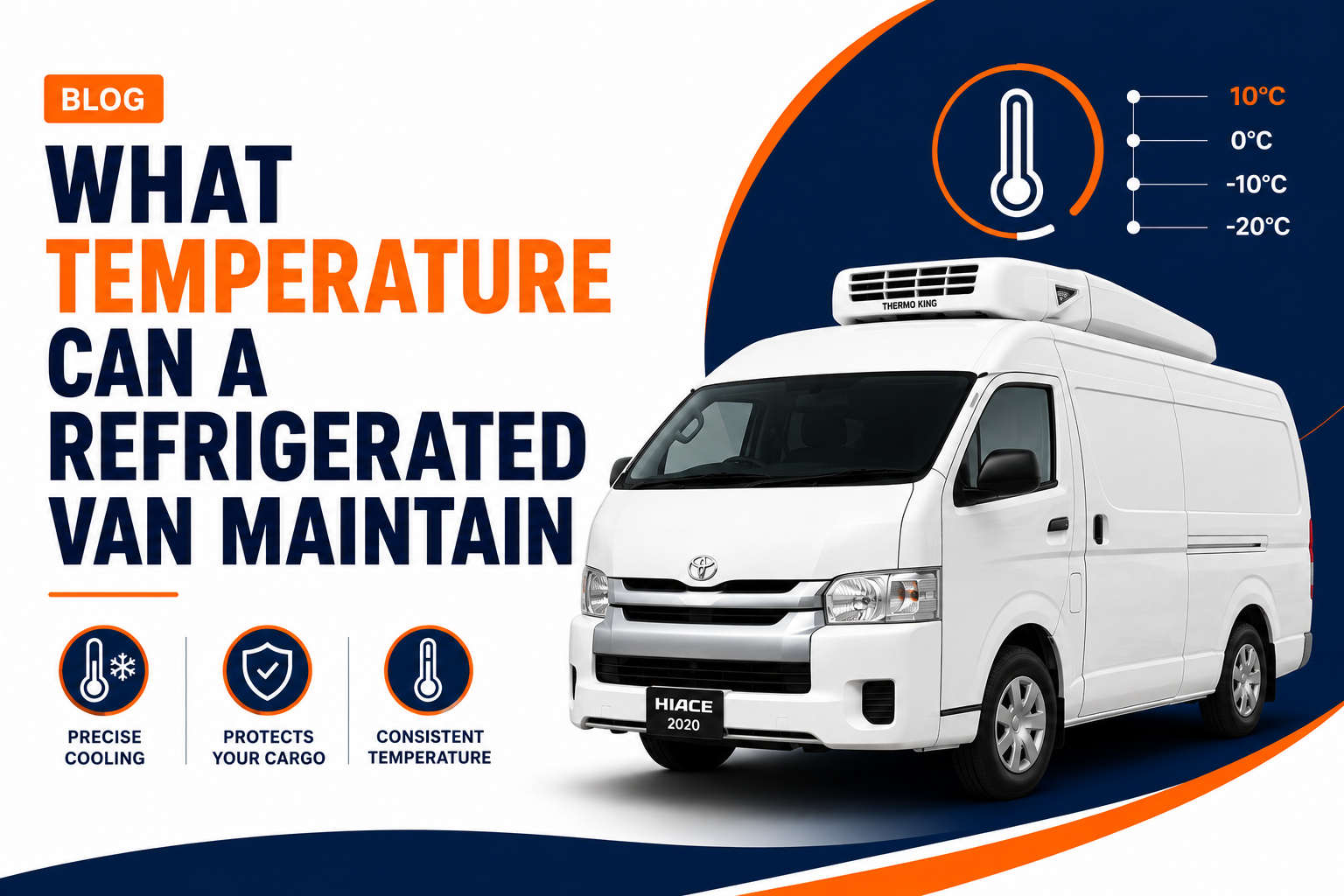
What Temperature Can a Refrigerated Van Maintain? Complete Range Guide for the UAE
Temperature is the single most important specification when choosing a chiller van for rent in the UAE. The wrong temperature setting means spoiled food, rejected pharmaceutical shipments, wilted flowers, or melted chocolate. Yet most rental enquiries start with “I need a chiller van” without specifying the exact temperature range required.
This guide covers the full temperature spectrum of refrigerated vehicles available in the UAE, explains the difference between chilled, frozen, and controlled room temperature categories, identifies which temperature range each product type requires, and answers the most common questions about how cold chain temperature works in practice.
Quick Answer: A refrigerated van in the UAE can maintain temperatures from plus 10 degrees Celsius down to minus 25 degrees Celsius, depending on the vehicle configuration. A chiller van maintains 0 to 8 degrees for fresh goods. A freezer van maintains minus 18 to minus 25 degrees for frozen goods. A reefer truck with a standalone unit can be set anywhere in the full minus 25 to plus 10 range. The achievable temperature depends on the refrigeration unit model, insulation thickness, ambient outside temperature, and how often the cargo doors are opened during delivery.
The Three Temperature Categories in Cold Chain Transport
The UAE cold chain industry operates across three primary temperature categories. Every product being transported falls into one of these bands, and the vehicle must be configured to match.
Category 1: Chilled (0 to +8 degrees Celsius)
This is the most common temperature range in the UAE rental market. It covers the widest variety of cargo types. A standard chiller van with 50mm insulation and a Carrier or Thermo King engine-driven unit maintains this range comfortably, even in UAE summer conditions.
Products requiring chilled transport:
- Fresh dairy (milk, yoghurt, cheese, butter): 0 to 4 degrees
- Fresh meat and poultry: 0 to 4 degrees
- Fresh seafood and fish: 0 to 2 degrees
- Fresh fruits and vegetables: 4 to 8 degrees
- Pre-prepared meals and sandwiches: 0 to 5 degrees
- Pharmaceutical products (GDP cold chain): 2 to 8 degrees
- Vaccines: 2 to 8 degrees
- Cut flowers and floral arrangements: 4 to 8 degrees
- Chocolate and confectionery: 4 to 8 degrees (critical in UAE summer)
- Beverages requiring chilling: 2 to 6 degrees
Category 2: Frozen (minus 18 to minus 25 degrees Celsius)
Frozen transport requires a freezer van or freezer truck with thicker insulation (75mm), a more powerful compressor, and R-404A refrigerant capable of reaching deep sub-zero temperatures. The cargo must arrive at the destination fully frozen with no evidence of thawing.
Products requiring frozen transport:
- Ice cream and gelato: minus 22 to minus 25 degrees
- Frozen meat and poultry: minus 18 degrees or below
- Frozen seafood: minus 18 degrees or below
- Frozen ready meals: minus 18 degrees
- Frozen bakery products (dough, pastry): minus 18 degrees
- Frozen vegetables and fruits: minus 18 degrees
Category 3: Controlled Room Temperature (CRT) (+15 to +25 degrees Celsius)
This category is often overlooked but critical for pharmaceutical products. Some medicines, clinical trial materials, and health supplements require controlled room temperature transport, which means the cargo area must be actively cooled to stay below 25 degrees during UAE summer when outside temperatures exceed 45 degrees. A standard chiller van set to 15 to 20 degrees handles this. Without active cooling, the inside of an unrefrigerated van in Dubai summer can exceed 60 degrees within 30 minutes.
Complete Temperature Reference Table by Product
| Product | Temp Range | Category | Vehicle Type |
| Fresh dairy | 0 to +4 C | Chilled | Chiller van or truck |
| Fresh meat/poultry | 0 to +4 C | Chilled | Chiller van or truck |
| Fresh seafood | 0 to +2 C | Chilled | Chiller van or truck |
| Fresh produce | +4 to +8 C | Chilled | Chiller van or truck |
| Prepared meals | 0 to +5 C | Chilled | Chiller van |
| Pharmaceuticals (cold chain) | +2 to +8 C | Chilled | Chiller van with data logger |
| Vaccines | +2 to +8 C | Chilled | Chiller van with data logger |
| Cut flowers | +4 to +8 C | Chilled | Chiller van |
| Chocolate/confectionery | +4 to +8 C | Chilled | Chiller van |
| Ice cream/gelato | -22 to -25 C | Frozen | Freezer van or truck |
| Frozen meat/seafood | -18 C or below | Frozen | Freezer van or truck |
| Frozen ready meals | -18 C | Frozen | Freezer van or truck |
| CRT pharmaceuticals | +15 to +25 C | Controlled room temp | Chiller van (set higher) |
This table covers the most common product types transported in the UAE. For specialised cargo not listed here, contact Al Sahara and our team will advise on the correct temperature setting and vehicle configuration.
Which Is Colder: a Fridge or a Chiller?
Quick Answer: In the UAE cold chain industry, the terms “fridge” and “chiller” mean the same thing when applied to vans: both maintain 0 to 8 degrees Celsius. There is no temperature difference between a fridge van and a chiller van. The terms are interchangeable. A “freezer” is colder than both, operating at minus 18 to minus 25 degrees.
Which Type of Chiller Is Best?
Quick Answer: The best type of chiller van for your business depends on three factors: what cargo you carry, how many stops your route has, and how far you deliver. For city multi-stop delivery of fresh food, dairy, or pharma under 1.5 tonnes, a Hiace-class chiller van is best. For wholesale delivery of 3 to 7 tonnes, a chiller truck is best. For adjustable temperature and cross-emirate bulk loads, a reefer truck is best. There is no single “best” chiller type across all use cases.
For a full breakdown by vehicle type, see our complete vehicle comparison guide.
What Is a Blast Chiller vs a Freezer?
Quick Answer: A blast chiller is a stationary unit (not a vehicle) that rapidly reduces food temperature from cooking temperature (above 70 degrees) to below 5 degrees within 90 minutes. It is used in commercial kitchens and food production facilities. A freezer van or freezer truck is a mobile vehicle that maintains already-frozen goods at minus 18 or below during transport. They serve different functions: a blast chiller cools food down quickly, a freezer vehicle keeps it cold during delivery.
In the context of refrigerated transport, you do not use a blast chiller inside a van. The food must already be at the correct temperature before loading into the vehicle. The vehicle’s job is to maintain that temperature during transit, not to cool the food down from a higher starting point. If hot food is loaded into a chiller van, the refrigeration unit cannot cool it down fast enough and the cargo temperature will exceed safe limits.
Which Is Better: AC or Chiller?
Quick Answer: Standard vehicle air conditioning (AC) cools the driver cab to a comfortable temperature (around 20 to 24 degrees) but cannot cool a cargo area to food-safe temperatures. A chiller van has a separate, dedicated refrigeration system for the cargo area that reaches 0 to 8 degrees. Vehicle AC and cargo refrigeration are completely different systems serving different purposes. You cannot transport perishable goods using vehicle AC alone.
What Is a Temperature-Controlled Van?
Quick Answer: A temperature-controlled van is any van where the cargo area temperature is actively managed by a refrigeration or heating system to stay within a specified range during transport. In the UAE, this almost always means a chiller van (0 to 8 degrees) or a freezer van (minus 18 to minus 25 degrees). The term “temperature-controlled” is the formal industry term used in regulatory compliance, GDP documentation, and cold chain audit reports.
Why Do You Need a Chiller?
You need a chiller van in the UAE because ambient temperatures regularly exceed 45 degrees Celsius for 5 to 6 months of the year. Without active refrigeration, the inside of a closed van in summer can reach 60 to 70 degrees within 30 minutes. At these temperatures:
- Fresh dairy spoils within 1 to 2 hours
- Fresh meat enters the bacterial danger zone (above 5 degrees) immediately
- Chocolate melts within minutes
- Pharmaceutical products lose efficacy permanently
- Cut flowers wilt and die within a single delivery run
Even in the UAE winter months (December to February), midday temperatures can reach 25 to 30 degrees, which still exceeds the safe transport range for dairy, meat, seafood, and pharmaceuticals. Year-round active refrigeration is not optional for any business transporting perishable or temperature-sensitive goods in the UAE.
Frequently Asked Questions
What temperature can a refrigerated van maintain?
A chiller van maintains 0 to 8 degrees Celsius. A freezer van maintains minus 18 to minus 25 degrees. A reefer truck with a standalone unit can be set anywhere from minus 25 to plus 10 degrees. The exact temperature achieved depends on the refrigeration unit, insulation, ambient heat, and door-opening frequency during delivery.
What is the difference between frozen and chilled cargo?
Chilled cargo is kept above zero (0 to 8 degrees) and remains in a fresh, unfrozen state. Examples: dairy, fresh meat, vegetables, pharma. Frozen cargo is kept below minus 18 degrees and must arrive fully solid with no signs of thawing. Examples: ice cream, frozen meat, frozen seafood, frozen ready meals.
Which is colder, a fridge or a chiller?
In the UAE van rental market, fridge and chiller mean the same thing: 0 to 8 degrees Celsius. There is no temperature difference. A freezer is colder than both, operating at minus 18 to minus 25 degrees.
Which type of chiller is best?
It depends on your cargo and route. A Hiace chiller van is best for city multi-stop delivery under 1.5 tonnes. A chiller truck is best for wholesale bulk delivery of 3 to 7 tonnes. A reefer truck is best for adjustable-temperature cross-emirate loads of 5 to 15 tonnes.
What is a blast chiller vs freezer?
A blast chiller is a stationary kitchen unit that rapidly cools hot food to below 5 degrees. A freezer van is a mobile vehicle that keeps already-frozen goods at minus 18 or below during transport. They serve different functions in the cold chain.
Which is better, AC or chiller?
Vehicle AC cools the driver cab to about 20 to 24 degrees. A chiller cools the cargo area to 0 to 8 degrees. They are completely different systems. You cannot use vehicle AC to transport perishable goods safely.
What is a temperature-controlled van?
A temperature-controlled van is any van with a dedicated refrigeration system maintaining a specified temperature range in the cargo area during transport. In the UAE, this typically means a chiller van (0 to 8 degrees) or a freezer van (minus 18 to minus 25 degrees).
Why do you need a chiller?
Because UAE ambient temperatures exceed 45 degrees for 5 to 6 months of the year. Without active refrigeration, perishable goods spoil within 1 to 2 hours inside a closed van. Even in winter, midday temperatures exceed the safe range for dairy, meat, and pharmaceuticals.
What is the difference between chiller and freezer van?
A chiller van maintains 0 to 8 degrees for fresh goods that must stay cold but not frozen. A freezer van maintains minus 18 to minus 25 degrees for goods that must remain fully frozen. They use different insulation thicknesses and different refrigerant gases.
Does chiller mean freezer?
No. A chiller keeps cargo above zero (0 to 8 degrees). A freezer keeps cargo below minus 18 degrees. They are different temperature ranges for different product types. Putting frozen goods in a chiller will cause them to thaw. Putting fresh goods in a freezer will damage them through ice crystal formation.
Need a refrigerated van at the right temperature for your cargo?
Contact Al Sahara at +971 52 373 7016, WhatsApp, or via our contact page. Tell us your product and we will recommend the exact temperature setting and vehicle type.

Abdul Basit
With over a decade of specialized experience in UAE's temperature-controlled logistics sector, I oversee critical cold-chain operations and compliance standards at Al Sahara. My expertise bridges the gap between stringent municipal HACCP regulations and practical, high-efficiency transport solutions for the F&B and pharmaceutical industries. I am deeply committed to sharing actionable insights on fleet management, GDP-compliant medical transport, and mitigating extreme-weather supply chain risks. Through these articles, I aim to equip local businesses with the knowledge needed to scale their operations securely and cost-effectively without compromising product integrity.