
Chiller Van Internal Dimensions: What Actually Fits

Most people size a chiller van by asking how many tons it carries. It is the wrong first question, and it is the reason so many bookings arrive with a van that is technically correct and practically too small.
A 1-ton chiller van will carry around 1.5 tons. Almost no chilled load ever gets near that figure. The body fills first — with trays, crates, boxes and roll cages — while the axle weight sits barely touched. If you have ever watched a driver close the doors on a van that is visibly full and been told it is “half loaded”, you have met this problem.
This guide covers what actually determines whether your cargo fits: the four measurements that matter, how much space the insulation quietly removes, estimated figures for a 1-ton chiller and freezer body with the arithmetic shown, and how to work out in about two minutes whether you need a standard body, a high roof, or something bigger.
The four measurements that decide it
Payload is a number on a form. These are the numbers that decide whether your stack of crates goes in the van.
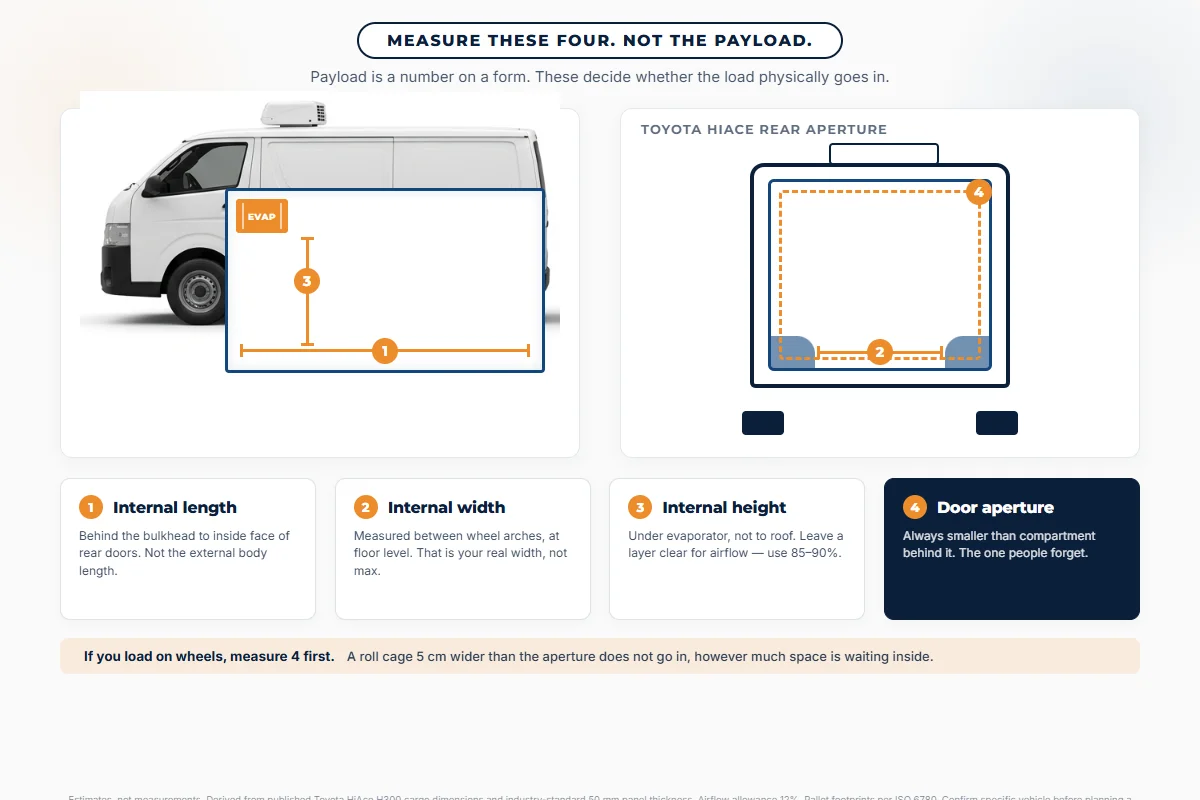
1. Internal length
Measured at floor level, from the back of the bulkhead to the inside face of the rear doors. Not the external body length, which includes panel thickness at both ends.
2. Internal width — specifically, between the wheel arches
This is the one that catches people out. A van body might be comfortably wide at shoulder height and considerably narrower at floor level, where the arches intrude. If you are loading anything rigid and wide — pallets, long trays, flat boxes — the between-arches figure is your real width, not the maximum width quoted on a spec sheet.
3. Internal height, measured under the evaporator
Not to the roof. The refrigeration evaporator hangs inside the compartment, usually at the front, and sometimes there is a second unit at mid-height. Your usable stacking height is whatever clears those units with air still able to move around them.
4. The rear door aperture
The opening is always smaller than the compartment behind it. Panel thickness, the door frame, hinges and the lock mechanism all take from it.
This matters when you are loading something that cannot be tilted or turned — a wheeled rack, a tall roll cage, a rigid display unit, a catering trolley. A trolley five centimetres wider than the aperture does not go in, no matter how much empty space is waiting inside.
How much space the insulation takes
This is the part that surprises people converting from a dry van.
A refrigerated body is built inside the vehicle. Insulated panel lines the floor, both sides, the roof and the doors, and it is meaningfully thick, because that thickness is what holds temperature through a UAE afternoon. Every one of those faces moves inward.
The effect compounds. Panel on both sides reduces the width twice over; panel on the floor and roof reduces the height twice over. A van that measures generously from the outside gives back noticeably less inside than the bare platform would suggest.

A freezer body takes more again. Holding −18°C to −25°C against a 45°C ambient needs heavier insulation than holding +4°C does, so the same external vehicle in freezer specification has a smaller internal compartment than the chiller version. If you are comparing a chiller quote and a freezer quote on the same platform, they are not offering you the same amount of space.
The practical consequence:never plan a load from the vehicle’s external dimensions, or from a manufacturer’s cargo figure for the unconverted van. Ask for the internal figures of the actual refrigerated body.
Volume or weight: which runs out first
Here is the two-minute test that answers the whole sizing question.
Take the weight of your typical load in kilograms. Take the space it occupies in cubic metres. Divide the first by the second. That is your cargo density.
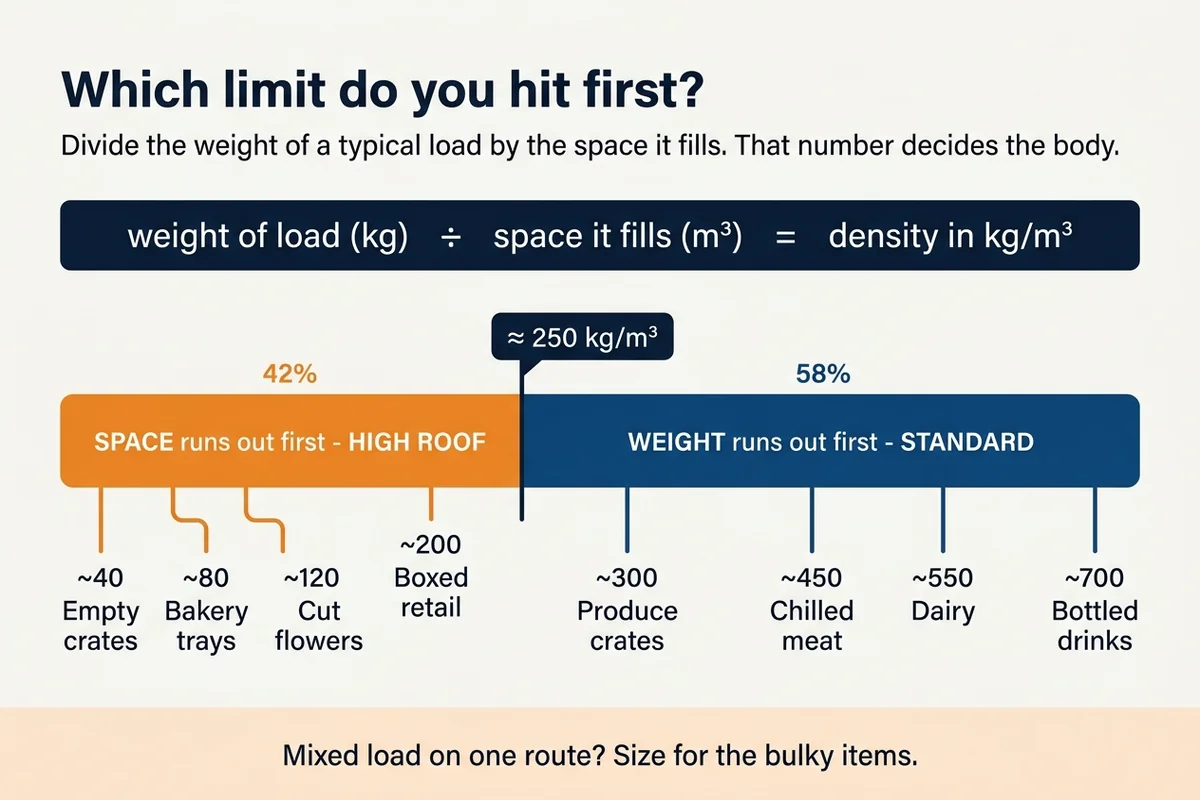
- Below about 250 kg/m³ — you will run out of space long before you run out of payload. A bigger body helps you. A bigger payload rating does nothing at all.
- Above about 250 kg/m³ — weight governs. A standard body is enough, and paying for extra cubic capacity is money you will not get back.
Where common chilled cargo actually sits:
| Cargo | Runs out of | Why |
|---|---|---|
| Bakery trays, pastries | Space, every time | Very light, very bulky, cannot be crushed |
| Cut flowers and plants | Space | Bulky, fragile, must not be stacked |
| Empty returnable crates | Space, dramatically | Almost weightless — pure volume |
| Packaged retail goods | Space, usually | Boxed air |
| Fresh produce in crates | Roughly balanced | Depends heavily on the product |
| Dairy, milk, yoghurt | Weight | Liquid is dense |
| Bottled beverages | Weight, quickly | The densest common chilled cargo |
| Frozen meat blocks | Weight | Dense and solid |
If your route mixes these — a hotel supply run carrying both beverages and bakery, say — size for the bulky items and accept that you will not use the payload. That is the correct answer, not a compromise.
Estimated figures for a 1-ton chiller and freezer body
Everything above is method. Here are the numbers, worked from two published inputs so you can check the arithmetic yourself rather than take our word for it.
The two inputs
1. The bare platform. The Toyota HiAce H300 is the most common 1-ton van platform in this market. Its published cargo area is 2530 mm long, 1760 mm wide and 1340 mm high in long-wheelbase form — about 6.2 m³ — narrowing to 1268 mm between the wheel arches. The super-long-wheelbase and high-roof variant runs 3180 mm by 1760 mm by 1615 mm, about 9.3 m³. Toyota notes its own dimensions are approximate.
2. The panel thickness. Van converters work to a settled convention: 50 mm of insulated panel for a chiller body and 75 mm for a freezer body. That sits inside the range the ATP agreement implies for chilled duty (50 to 75 mm) and frozen duty (75 to 100 mm). Rigid closed-cell polyurethane is the usual material, chosen for insulating value per millimetre.
Panel lines all six faces, so each dimension loses twice the thickness — once at each end, each side, the floor and the roof.

The resulting estimates
| Standard chiller | Standard freezer | High roof chiller | High roof freezer | |
|---|---|---|---|---|
| Panel thickness | 50 mm | 75 mm | 50 mm | 75 mm |
| Internal length | ~2430 mm | ~2380 mm | ~3080 mm | ~3030 mm |
| Internal width | ~1660 mm | ~1610 mm | ~1660 mm | ~1610 mm |
| Between wheel arches | ~1168 mm | ~1118 mm | ~1168 mm | ~1118 mm |
| Internal height | ~1240 mm | ~1190 mm | ~1515 mm | ~1465 mm |
| Usable height after airflow | ~1090 mm | ~1050 mm | ~1330 mm | ~1290 mm |
| Volume | ~5 m³ | ~4.6 m³ | ~7.7 m³ | ~7.1 m³ |
| Usable volume | ~4.4 m³ | ~4 m³ | ~6.8 m³ | ~6.3 m³ |
| Lost to insulation | ~19% | ~26% | ~17% | ~23% |
Two things in that table are worth sitting with. A freezer body on the same platform gives you roughly 8% less volume than the chiller version, which is why a chiller and a freezer quote on the same van are not offers of the same space. And the usable figure — after the airflow allowance — is around 4.4 m³ on a standard chiller body, against 6.2 m³ for the bare platform. Plan against the usable number.
How many crates that is
A common Euro-modular stackable food crate measures 600 × 400 × 300 mm. At that height you get 3 layers in a standard chiller body and 4 layers in a high roof — the extra layer that decides whether the taller body is worth its daily rate.
Shallower units change the arithmetic. A 600 × 400 × 200 mm tray gives 5 layers standard and 6 high roof. Always run the number against your unit height rather than assuming the taller body adds a layer — sometimes it adds one, sometimes it adds none.
Can you fit a pallet? Almost certainly not
This comes up constantly, so it is worth being blunt about.
A van of this class is a hand-loaded vehicle. Cargo goes in as crates, trays, boxes or roll cages through the rear and side doors. There is no tail lift, the floor sits at a height a forklift cannot easily serve, and the aperture is not sized for pallet handling.
The two ISO 6780 footprints you will meet here are the industrial pallet at 1200 × 1000 mm and the Euro pallet at 1200 × 800 mm.
Run those against the estimates above and the picture is specific. The between-arches width of a chiller body is about 1168 mm, so a single pallet footprint does sit on the floor — 800 mm or 1000 mm across both clear it. Two side by side would need 1600 mm and do not.
But a Euro pallet deck is 144 mm before anything goes on it. Add a metre of stock and you are at 1144 mm against roughly 1090 mm of usable height. The footprint fits and the load does not — and even if it did, a forklift cannot reach into a van body to place it, and hand-loading a pallet defeats the point of palletising.
If your goods arrive and leave on pallets, you want a truck. A 3-ton reefer truck has a tail lift and a body designed for pallet handling. It costs more per day, but your cost per pallet moved will be lower and your loading time will collapse.
Why you cannot use all the space you measure
Even with the right van, two things stop you filling it to the roof.
The evaporator needs clear air
The unit blows cold air along the compartment and needs to draw it back. Stack tight against the evaporator, or block the return path at the front of the body, and the unit ends up recirculating its own discharge air. The temperature gauge reads correctly at the sensor while the cargo at the back sits several degrees warmer.
This is the single most common cause of a load arriving out of specification in a vehicle that was working perfectly.
Air needs to move around the cargo
Leave a gap at the ceiling, keep the load off the front bulkhead, and do not seal the floor channels if the body has them. In practice, plan to use around 85 to 90 per cent of the measured internal height, not 100 per cent.
Loading to the absolute roof is a false economy. You gain one layer of stock and risk the entire load.
Working out your own requirement
A method you can apply in a few minutes with a tape measure:
- Measure one unit of your cargo — one crate, one tray, one carton. Length, width, height.
- Count how many you move on a typical run. Use a busy day, not an average one.
- Work out your footprint. How many units fit side by side across the width, allowing for the wheel arches? How many rows front to back?
- Work out your stack height. Unit height into usable internal height, then subtract one layer for airflow.
- Multiply. Units across × rows deep × layers high = what the van holds.
- Check the weight. Units × unit weight. If this exceeds the payload, you are weight-limited and can stop worrying about volume.
- Check your widest rolling item against the door aperture.
If step 5 gives you less than you need and step 6 shows you are nowhere near the payload, the answer is a high roof chiller van — same footprint, same licence category, an extra stacking layer. If step 5 is short and step 6 is close to the limit, you need a bigger vehicle class entirely.
Which vehicle the answer points to
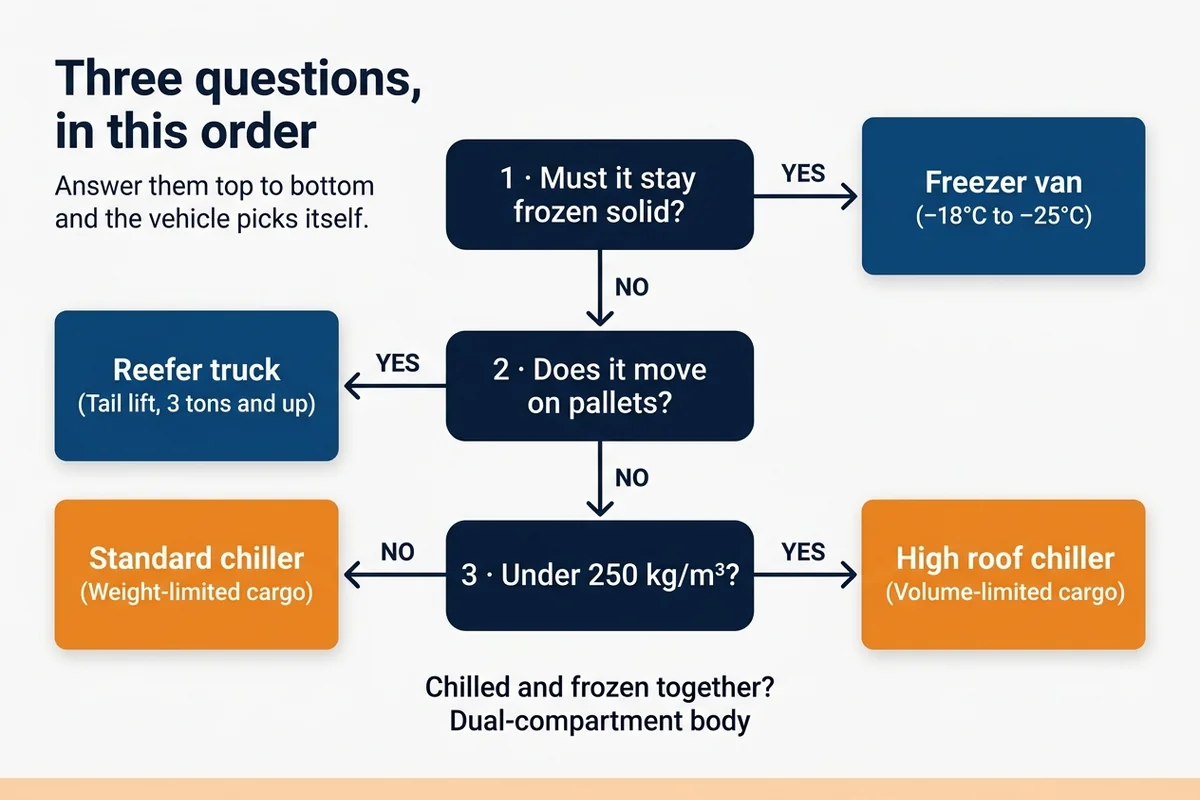
| Your situation | Vehicle | Why |
|---|---|---|
| Hand-loaded, fits a standard body | 1-ton chiller van | Cheapest to hire and run, best city access |
| Bulky and light, body fills first | High roof chiller van | Same footprint and licence, more cubic capacity |
| Must stay frozen solid | 1-ton freezer van | Chiller units stop around 0°C |
| Over ~3 tons, or palletised | 3-ton reefer truck | Tail lift, pallet handling, lower cost per pallet |
| Chilled and frozen on one run | Dual-compartment body | A bulkhead splits the box into two set points |
Getting the figures for your vehicle
The estimates above will tell you which class of van you need. They will not tell you whether a particular rack clears a particular door, because that depends on the specific conversion.
Four figures are worth asking for before you commit: the internal length, the width between the arches, the height under the evaporator, and the rear door aperture. Any operator who cannot give you those for the actual vehicle is guessing on your behalf.
Start with the Toyota Hiace chiller van specs or the high roof chiller van, and ask us for the measured figures on the van we would send you.
Tell us what you are moving, how it is packaged and whether it is on wheels, and we will tell you which body fits it — including when the answer is that you need less van than you thought. See the full refrigerated van rental range, or go straight to chiller van rental.
If you already know the load is bulky and light, the next question is whether the extra height pays for itself: high roof or standard chiller van.
Frequently Asked Questions
- What are the internal dimensions of a 1-ton chiller van?
- As an estimate, roughly 2,430 mm long by 1,660 mm wide by 1,240 mm high on a HiAce H300 long-wheelbase platform with a standard 50 mm chiller body — about 5.0 cubic metres, or 4.4 usable once you allow for airflow. Between the wheel arches it narrows to about 1,168 mm. A freezer body at 75 mm panel gives roughly 2,380 by 1,610 by 1,190 mm. These are calculated from the published platform dimensions and the standard panel thickness, not measured on a specific van, so confirm the actual figures before planning a load — a real conversion can differ by 30 to 50 mm in any direction.
- How many pallets fit in a chiller van?
- In practical terms, none. Vans of this class are hand-loaded through rear and side doors, with no tail lift and no forklift access. Even where a pallet footprint would physically sit on the floor, you cannot get it in there mechanically. If your goods move on pallets you need a refrigerated truck with a tail lift.
- Why does my van look full when it is only carrying 400 kg?
- Because your cargo is bulky and light. Below roughly 250 kg per cubic metre the body fills long before the payload is reached. This is completely normal for bakery, flowers, empty crates and boxed retail goods. The fix is more cubic capacity — a high roof body — rather than a higher payload rating, which would do nothing for you.
- Does a freezer van have less space than a chiller van?
- Yes, on the same platform. Holding -18°C to -25°C against a UAE summer ambient requires thicker insulation than holding +4°C, and that thickness comes off the internal compartment in every direction. Worth factoring in when you are comparing a chiller and a freezer quote on the same vehicle.
- Can I load a chiller van to the roof?
- You should not. The evaporator needs clear air around it and the cold air needs a return path along the compartment. A load stacked to the ceiling or packed against the front bulkhead makes the unit recirculate its own discharge air: the gauge reads correctly at the sensor while cargo at the back of the body sits several degrees warmer. Plan to use about 85 to 90 per cent of the measured internal height.
- What is the widest thing I can get through the rear doors?
- Less than the internal width. Panel thickness, the door frame, hinges and the lock mechanism all take from the opening, so the aperture is always smaller than the compartment behind it. If you load roll cages or trolleys, measure your widest one and ask for the aperture figure before booking.
- Should I size the van by weight or by volume?
- By whichever runs out first, which for most chilled cargo is volume. Divide the weight of a typical load by the space it occupies. Below about 250 kg per cubic metre you are volume-limited and should size by cubic capacity. Above it you are weight-limited and payload is the number that matters.
Need a van sized to your actual load?
Tell us what you are moving, how it is packaged and the route. We will tell you which body fits — including when the answer is that you need less van than you thought.