
High Roof or Standard Chiller Van: Which Limit Do You Hit First?

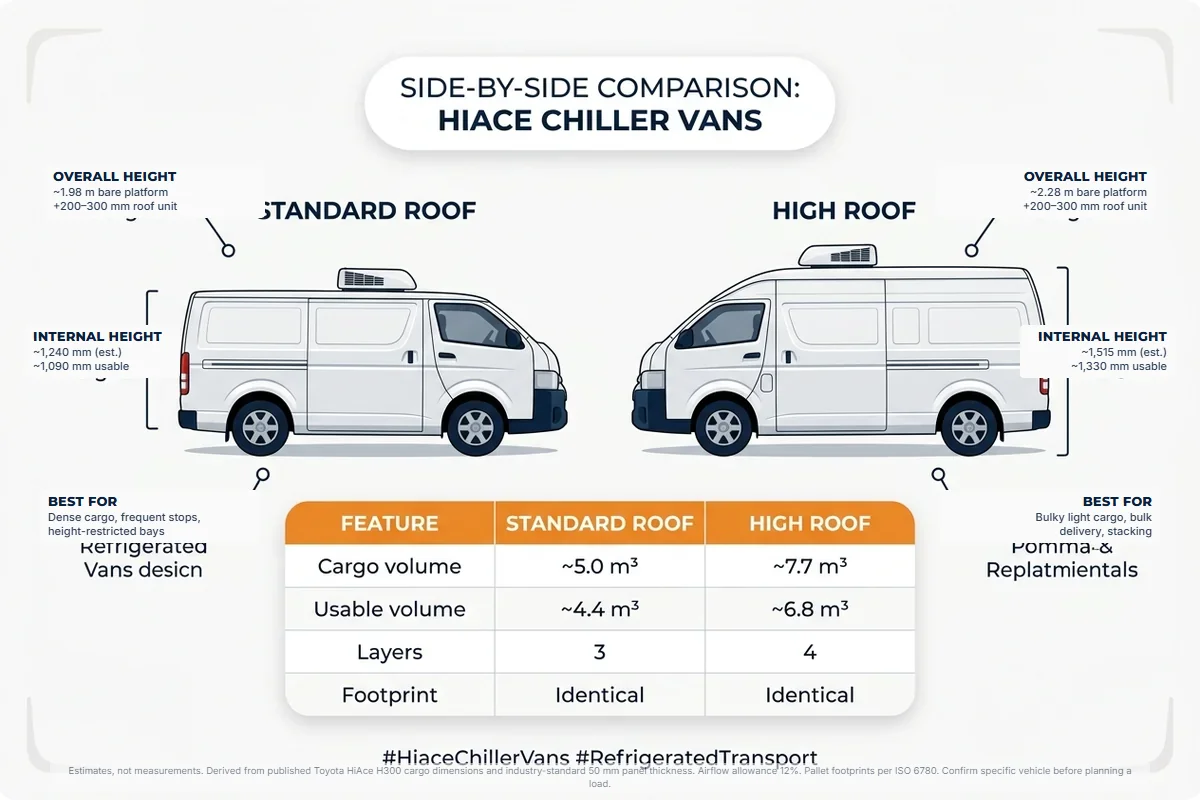
Two vans, same platform, same licence, same temperature range, same parking footprint. One costs more per day than the other. The only meaningful difference is how tall the box is.
Most people choose by price, which means most people choose the standard roof — and that is the wrong answer for a surprising share of chilled work in this market. Here is how to decide properly, in about two minutes.
The only question that matters
Does your cargo run out of space before it runs out of weight?
That is the whole decision. Everything else is detail.
A van has two limits. It can carry a certain weight, and it can hold a certain volume. Whichever you hit first is your real constraint, and the other one is irrelevant.
- If you hit the weight limit with space to spare, a taller body gives you nothing. You are paying more per day to carry air.
- If you hit the volume limit with payload to spare, a taller body is the cheapest capacity you can buy — another stacking layer for the same footprint, the same licence and the same parking space.
The mistake is assuming that because a van is rated at 1.5 tons, you will use 1.5 tons. Most chilled cargo never comes close.
The number that tells you: cargo density
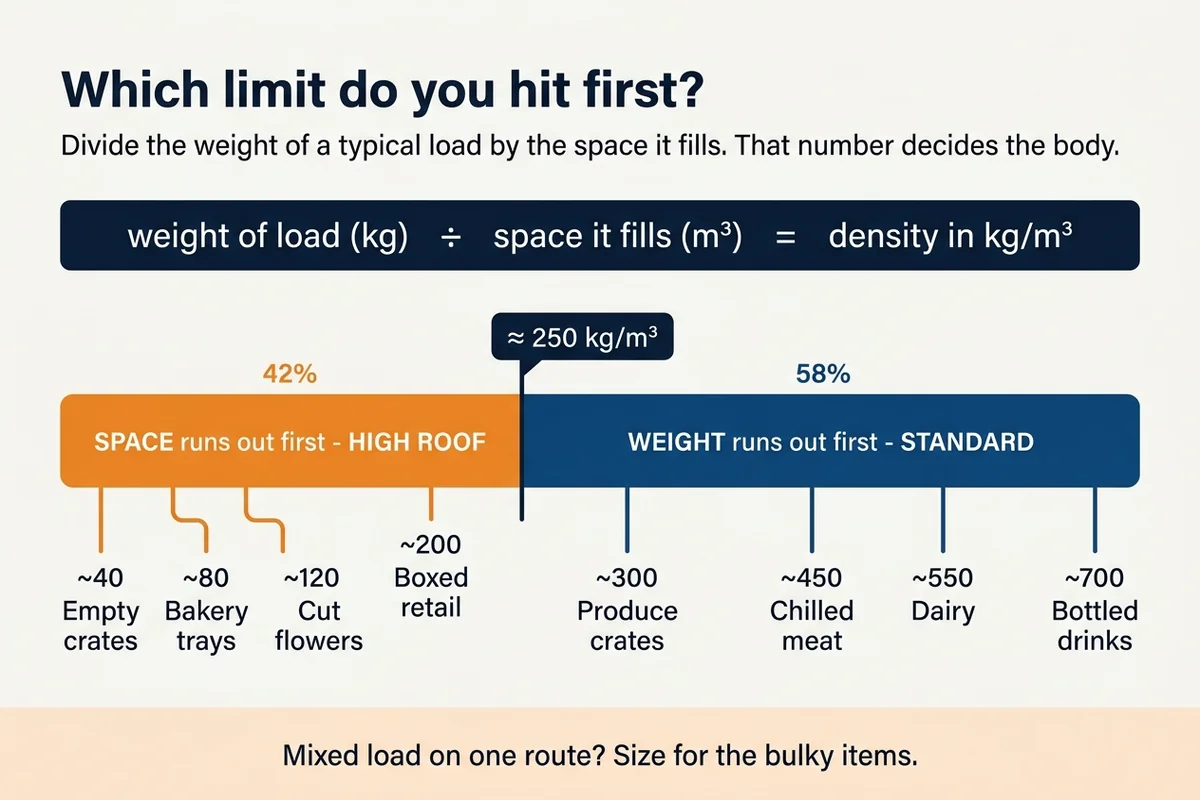
Work out the weight of a typical load and the space it occupies, then divide.
Weight (kg) ÷ volume (m³) = density in kg/m³
- Below ~250 kg/m³ → volume-limited. High roof.
- Above ~250 kg/m³ → weight-limited. Standard roof.
Two worked examples
A bakery running morning deliveries.Fifty trays of pastries. Each tray weighs about 4 kg and occupies roughly 0.05 m³. That is 200 kg in 2.5 m³ — a density of 80 kg/m³. Nowhere near the payload, comprehensively out of space. This operator should never hire a standard roof.
A dairy distributor.Forty crates of bottled milk. Each crate about 20 kg in roughly 0.04 m³. That is 800 kg in 1.6 m³ — 500 kg/m³. This operator will hit the weight limit with the body half empty. A high roof would be money burned.
Same van class, opposite answers.
Where common cargo falls
| Cargo | Density | Body |
|---|---|---|
| Empty returnable crates | Very low | High roof, always |
| Bakery trays, pastries, bread | Very low | High roof |
| Cut flowers and plants | Very low | High roof |
| Boxed retail and packaged goods | Low | High roof usually |
| Fruit and vegetables in crates | Low to medium | Depends on produce — measure it |
| Prepared meals, catering trays | Medium | Roughly balanced |
| Chilled meat and poultry in crates | Medium to high | Standard usually |
| Dairy, yoghurt, milk | High | Standard |
| Bottled and canned beverages | Very high | Standard, always |
| Frozen meat blocks | Very high | Standard |
If you carry a mix, size for the bulky items. You will not use the payload, and that is the correct outcome rather than a compromise.
What you actually gain
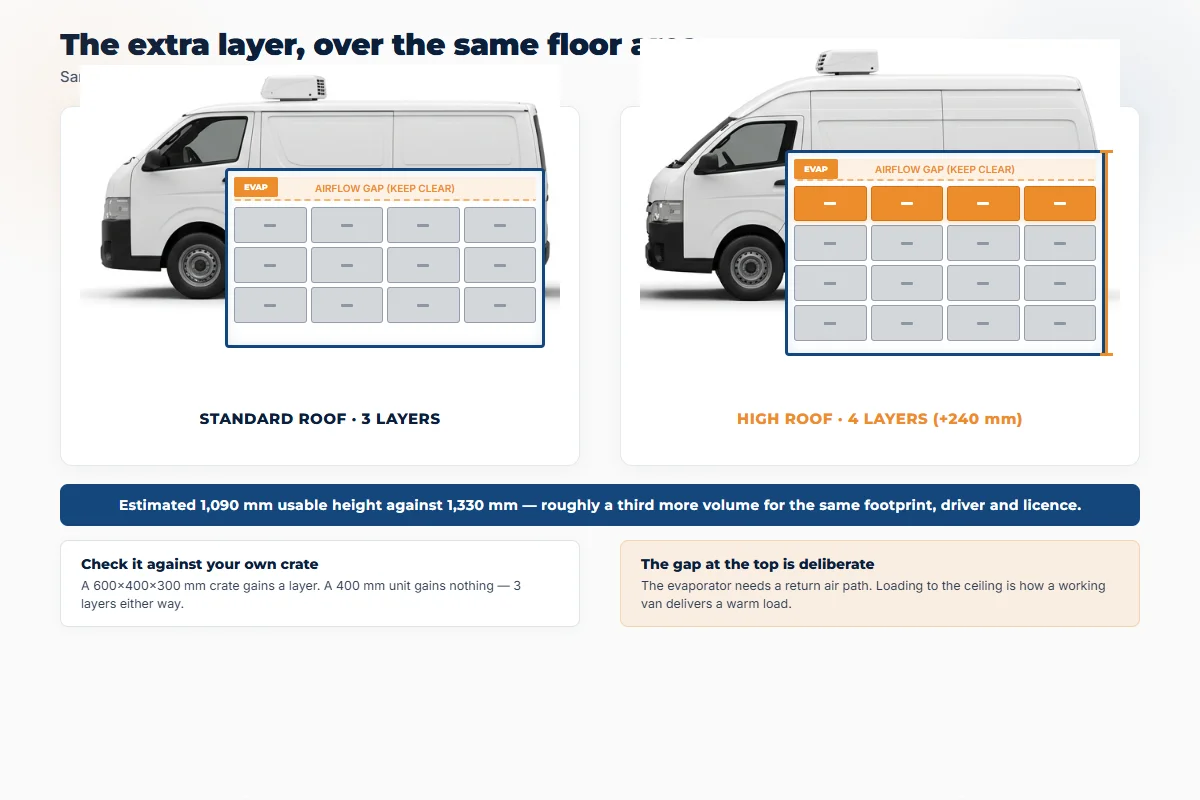
An extra stacking layer
This is the real benefit, and it is worth more than the height figure suggests. But extra height only helps if it is enough to fit another full layer of whatever you stack. Going up by half a tray height gains you nothing at all.
What the extra layer is worth, in numbers
Estimating from the published platform dimensions and the standard 50 mm chiller panel, a standard body gives roughly 1090 mm of usable height once you allow for airflow, and a high roof about 1330 mm. In volume that is around 4.4 m³ against 6.8 m³.
Put a common Euro-modular crate through that — 600 × 400 × 300 mm — and you get 3 layers standard against 4 layers high roof. That is the extra layer, and on volume-limited cargo it is roughly a third more payload per trip for the same footprint, driver and licence.
Now change the unit height and watch the case move. A shallower 600 × 400 × 200 mm tray gives 5 layers standard and 6 high roof — still a gain. A tall 400 mm unit gives 2 and 3: the same. Run the arithmetic against your own unit height before you pay the premium, because the taller body does not always buy you a layer.
These are estimates derived from published platform figures and the standard panel thickness, not measurements of a specific van. They are reliable enough to choose a body class and not reliable enough to plan a rack against.
Standing room, and what it does to loading time
On a multi-drop route where the driver goes in and out of the body twenty times a day, being able to move inside without stooping adds up across a shift. It is a genuine operational difference on dense city routes, even though it never appears on a spec sheet.
Better stock rotation
More height means you can organise by drop order vertically rather than burying the last delivery behind the first. Fewer items shifted at each stop means fewer door-open minutes, which means better arrival temperature.
What it costs you
Being honest about the trade-offs, because there are real ones.
Height restrictions. This is the one that causes actual problems. Mall loading bays, hotel service entrances, basement car parks and some older commercial buildings have height limits. A standard roof clears most of them. A high roof does not always. Check the height of every bay on your route before you book — discovering it at the barrier costs you the delivery window.
Fuel and wind. A taller box has more frontal area and catches more crosswind. Over a long inland run the fuel difference is noticeable, though on stop-start city work it is marginal.
Cooling load. More volume is more air to keep cold. The unit is specified for it, but a bigger box takes slightly longer to pull down from ambient — one more reason to accept the vehicle pre-cooled rather than cooling it at your dock.
Daily rate. Higher. But if you are volume-limited, your cost per cubic metre carried is lower, and that is the figure that matters. If you are weight-limited, you are simply paying more for nothing.
Side by side
| Standard Roof | High Roof | |
|---|---|---|
| Limit you hit first | Weight, on dense cargo | Volume, on bulky light cargo |
| Usable height (est.) | ~1090 mm | ~1330 mm |
| Usable volume (est.) | ~4.4 m³ | ~6.8 m³ |
| Layers of a 600×400×300 crate | 3 | 4 |
| Suits | Beverages, dairy, chilled meat, frozen blocks | Bakery, flowers, empty crates, packaged retail |
| Footprint and parking | Identical | Identical |
| Licence category | Standard UAE light vehicle | Standard UAE light vehicle |
| Height-restricted bays | Clears most | Check before booking |
| Temperature range | 0°C to +8°C | 0°C to +8°C |
| Cost per day | Lower | Higher |
| Cost per m³ carried | Higher | Lower |
Note the two rows people get wrong: the licence is the same, and the parking footprint is the same. A high roof is not a bigger vehicle to drive or to park. It is the same vehicle with a taller box.
What about the freezer version?
The same choice exists in freezer specification, with one extra consideration.
A freezer body needs heavier insulation to hold −18°C to −25°C against a UAE summer ambient, and that insulation takes internal space in every direction — including height. So a high-roof freezer body gives you less additional clearance over a standard freezer body than the equivalent comparison in chiller specification.
If you run frozen cargo that is bulky and light — ice cream in display cartons, frozen bakery, packaged frozen ready meals — the high roof still wins. Just measure the actual clearance rather than assuming it matches the chiller figure. The 1-ton freezer van page has the specification.
The three-question version
If you want to skip the arithmetic:
- Does your load fill the van while the suspension is barely working? → High roof.
- Does the van sit low on its springs with room left inside?→ Standard roof.
- Are there height-restricted bays on your route?→ Measure them before you book, whatever the answer to 1 and 2.
Most operators know the answer to the first two from watching their own vans load. Trust that observation over the payload figure on the paperwork.
Getting the right one
We run both bodies in chiller and freezer specification. Tell us what you move, how it is packaged, and whether there are height limits on your route, and we will tell you which one fits — including when the answer is that the cheaper standard body is all you need.
For the full specification of each, see the high roof chiller van specs and the Toyota Hiace chiller van. If you are still working out your load before you compare bodies, start with chiller van internal dimensions.
Renting in the capital? We stage high roof bodies in Musaffah — see high roof chiller van in Abu Dhabi. For the wider range, see chiller van rental.
Frequently Asked Questions
- What is the difference between a high roof and a standard chiller van?
- The height of the insulated body, and nothing else that matters. Same platform, same footprint, same licence category, same 0°C to +8°C range. As an estimate, a standard chiller body gives around 1,090 mm of usable height and 4.4 cubic metres, against roughly 1,330 mm and 6.8 cubic metres for a high roof — typically one extra stacking layer for the same floor area. Confirm the figures for the specific vehicle before planning a load.
- Do I need a different licence for a high roof van?
- No. Both sit within the standard UAE light vehicle licence category, so you can put the same drivers in either on a self-drive hire without arranging a heavier category first.
- Is a high roof van harder to park?
- The footprint is identical, so the parking space is the same. The constraint is height, not length or width: check mall loading bays, hotel service entrances and basement car parks on your route before you book.
- Does a high roof van cost more to hire?
- Yes, per day. But if your cargo is bulky and light, your cost per cubic metre carried is lower, and that is the figure that matters. If your cargo is dense and you hit the weight limit first, the extra height earns you nothing.
- How do I know if my cargo is bulky or dense?
- Divide the weight of a typical load by the space it occupies. Below roughly 250 kg per cubic metre you are volume-limited and want the high roof. Above that you are weight-limited and the standard body is enough.
- Can I get a high roof body as a freezer?
- Yes. Note that freezer insulation is thicker than chiller insulation, so the internal clearance gain over a standard freezer body is smaller than the equivalent chiller comparison. Worth measuring rather than assuming.
- Does a taller body hold temperature less well?
- No, provided the unit is specified for the volume, which ours are. There is more air to cool, so pull-down from ambient takes slightly longer — which is why we dispatch pre-cooled rather than expecting the van to reach temperature at your dock.
Need a van sized to your actual load?
Tell us what you are moving, how it is packaged and the route. We will tell you which body fits — including when the answer is that you need less van than you thought.