
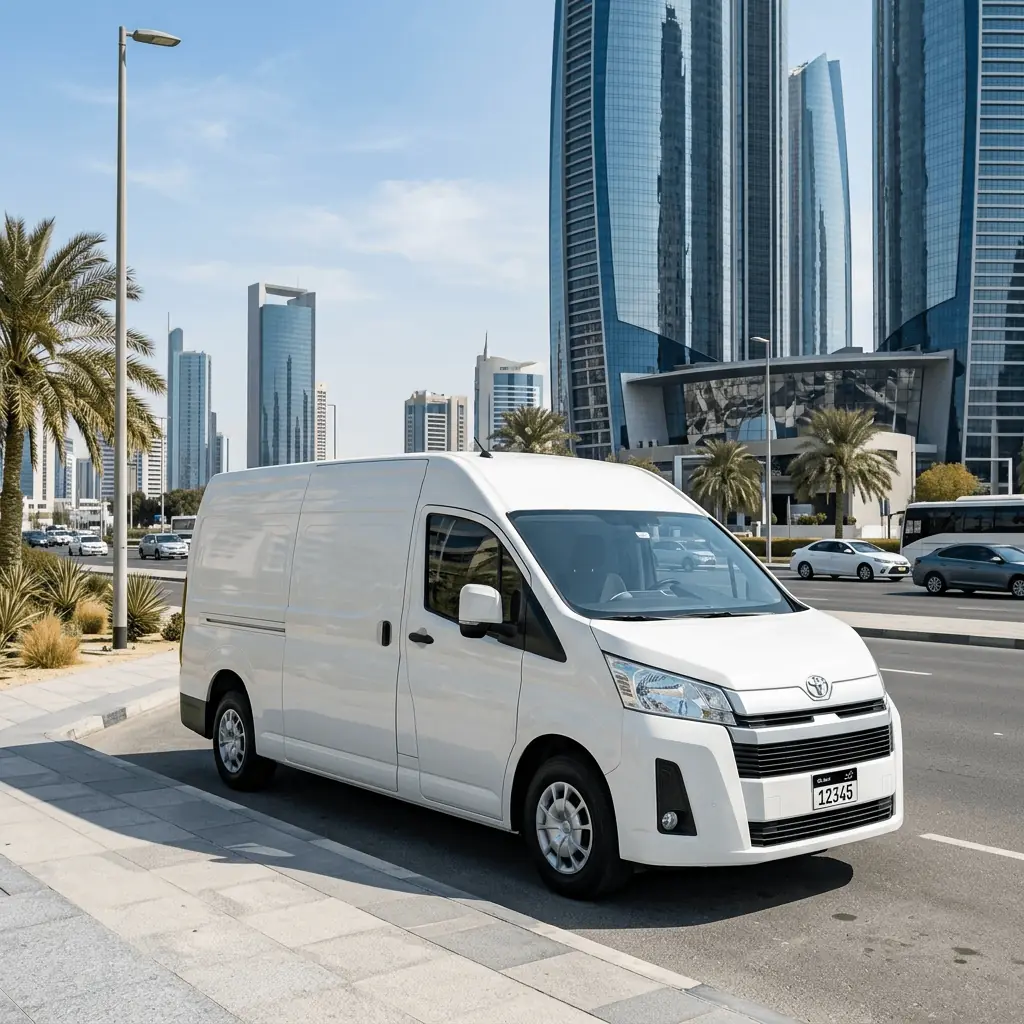
Vehicle Details
The 1-Ton Hiace Chiller Van is our most agile and popular vehicle for urban cold-chain logistics. Designed to navigate narrow city streets while maintaining perfect temperature stability, it is the ideal choice for quick distribution of fresh produce, dairy, and sensitive medical supplies. Available for rent across Dubai, Abu Dhabi, and Sharjah.
Rental terms, coverage and hire options: chiller van rental and refrigerated van rental.
1-Ton Hiace Chiller Van
Fresh food, dairy, wholesale distribution, pharmaceuticals, and fast city delivery.
Key Specifications
- HACCP-Compliant Refrigeration
- Real-time Temperature Monitoring
- Compact for Urban Navigation
- Same-Day Dispatch Availability
Quick Answers
- Temperature held
- 0°C to +8°C, logged continuously for the whole journey.
- Payload
- Up to roughly 1.5 tons, depending on body and fit-out.
- Best for
- City multi-drop routes with many short stops and tight access.
- Refrigeration
- Roof-mounted Carrier or Thermo King unit, pre-cooled before dispatch.
- Driver
- Optional. Self-drive needs a valid UAE licence and a refundable deposit.
- Freezer version
- The same platform is available at -18°C to -25°C as a freezer van.
Full Specification
| Platform | Toyota Hiace, standard roof |
|---|---|
| Payload | Up to ~1.5 tons |
| Temperature range | 0°C to +8°C (chiller configuration) |
| Refrigeration unit | Roof-mounted Carrier / Thermo King |
| Body | Insulated panel, seamless hygienic lining |
| Access | Rear doors plus nearside sliding door |
| Monitoring | Digital temperature logging, printable records |
| Compliance | HACCP, Dubai Municipality cold-chain approved |
Estimated Internal Dimensions
Worked from the published HiAce H300 long-wheelbase cargo area (2530 x 1760 x 1340 mm, about 6.2 m3) less the standard 50 mm of insulated panel on all six faces.
| Internal length | ~2430 mm |
|---|---|
| Internal width | ~1660 mm |
| Width between wheel arches | ~1168 mm |
| Internal height | ~1240 mm |
| Usable height after airflow | ~1090 mm |
| Volume | ~5 m³ (about 4.4 m³ usable) |
| Lost to insulation | ~19% of the bare platform |
| Panel thickness | 50 mm, chiller specification |
These are estimates, not measurements of this vehicle. They combine the published cargo area of the donor platform with the industry-standard insulated panel thickness, so they are reliable for choosing a vehicle class and not for planning a rack against. A real conversion varies by converter, panel specification and evaporator model. Ask us for the measured figures on the van we would send you.
Sizing a Hiace Chiller Van to Your Load
Almost every sizing conversation we have starts with weight, and almost every one of them should start with volume. A 1-ton Hiace chiller van carries up to roughly 1.5 tons, but very few chilled loads reach that figure before the body is full. Bakery trays, packaged produce, empty returnable crates and boxed retail stock all fill the compartment while the axle load is barely touched.
The rough test is cargo density. Take the weight of your load and the space it occupies. Below about 250 kg per cubic metre you will run out of room first, and a bigger body helps you more than a bigger payload rating. Above that, weight governs and a standard body is enough.
Two things eat into the space people expect. The insulated panel takes thickness off every internal face, so the usable compartment is meaningfully smaller than the van looks from outside. The evaporator also needs clear air around it, which means you cannot stack tight to the ceiling or block the return path at the front of the body. Loading to the roof is the single most common reason a van that should hold temperature does not.
How This Van Behaves on a Real City Route
A chiller van on a multi-drop route spends much of its day with the doors open. Every opening at a UAE summer ambient dumps cold air out of the box in seconds, and the unit then works to pull it back. That is normal and the vehicle is specified for it, but it means the way the route is run affects cargo condition more than the vehicle specification does.
We dispatch pre-cooled. The compartment is pulled down to your set point before the van leaves the depot, so the first load goes into a cold box rather than a warm one. A van that arrives still cooling has already cost you the first drop.
On routes with many short stops the practical advice is unglamorous: plan the drop order so the last item loaded is the first delivered, keep the doors shut between drops rather than propped, and do not stack against the evaporator. Those three habits do more for arrival temperature than any upgrade.
Why the Hiace Is the Default Chiller Van in the UAE
It matches the work. Much of the chilled distribution in this market is multi-drop into places a larger vehicle cannot reach comfortably: older Deira streets, the tighter parts of Al Quoz, hotel and restaurant service entrances, and mall loading bays with height limits and timed access windows.
It is also economical across a long day of stop-start driving, and mechanically well understood here. Parts and servicing are widely available in the UAE, which matters more than it sounds when a vehicle is on a daily route and a day off the road is a day of missed deliveries.
The licence category is the quiet advantage. A standard UAE light vehicle licence covers it, so you can put your own staff behind the wheel on a self-drive hire without arranging a heavier category first.
When to Step Up From This Van
The Hiace stops being the right answer in a few situations, and each one points somewhere different.
| If this is true | What you need | Why |
|---|---|---|
| The body fills before the weight limit | High roof chiller van | Same footprint and licence, more cubic capacity and another stacking layer |
| Cargo must stay frozen solid | 1-ton freezer van | A chiller unit stops around 0°C; frozen stock needs -18°C to -25°C and heavier insulation |
| Load is above ~3 tons, or moves on pallets | 3-ton reefer truck | Pallet handling and tail-lift loading; cost per pallet falls even as cost per day rises |
| Chilled and frozen on one run | Dual-compartment body | A bulkhead splits the box into two set points, so one vehicle covers both bands |
| Same vehicle needed for months | Long-term lease | Lease terms price differently from daily hire and cover maintenance and downtime |
What It Suits
- —Restaurant and café supply on multi-drop city routes
- —Fresh produce, dairy and chilled meat distribution
- —Bakery and pastry deliveries in the early morning window
- —Pharmacy and clinic replenishment at 2°C to 8°C
- —Flower and event supply where access is tight
- —Hotel and restaurant service-entrance deliveries with timed access windows
- —Returnable crate collection runs where the load is bulky but light
- —Event and catering supply into venues with height-restricted loading bays
What it is not for: Frozen cargo. A chiller unit stops around 0°C, so anything that must stay frozen solid needs the freezer configuration instead.
Frequently Asked Questions
How much can a 1-ton Hiace chiller van actually carry?
Up to roughly 1.5 tons depending on the body and fit-out, but in practice most loads run out of space before they run out of weight. Bakery trays, packaged produce and stacked crates fill the body while the axle weight is barely touched. If that describes your cargo, the high-roof body carries meaningfully more for the same footprint and licence category.
Why is the Hiace the most common chiller van in the UAE?
It suits the work. It is agile enough for Deira and older Al Quoz streets where a larger van struggles, economical over a long multi-drop day, and mechanically robust enough that a refrigerated conversion on that platform holds up through a Gulf summer. Parts and servicing are widely available here, which matters more than it sounds when a vehicle is on a daily route.
Can this van be supplied as a freezer?
Yes. The same platform takes a freezer specification at -18°C to -25°C, with heavier insulation and a higher-capacity unit. Dual-compartment fit-outs are also possible, splitting chilled and frozen behind a bulkhead for routes that carry both.
Is it available with a driver?
Both ways. With a trained cold-chain driver, or self-drive against a valid UAE licence of the correct category and a refundable security deposit. For multi-drop city routes most customers take a driver, because door discipline and stacking affect cargo condition more than the vehicle does.
What internal dimensions does the Hiace chiller van have?
Ask us for the figures on the specific vehicle before you book, because the insulated body reduces the internal compartment against the bare platform and the exact loss varies with the panel specification of that conversion. What we can tell you reliably is the practical outcome: if your load is bulky and light it will fill the body before it reaches 1.5 tons, and the high-roof body is the sensible next step rather than a larger payload rating.
How many pallets fit in a 1-ton Hiace chiller van?
Realistically none, if you mean standard pallets moved by forklift. A van of this class is hand-loaded: cargo goes in as crates, trays, boxes or roll cages through the rear and side doors. If your goods arrive and leave on pallets you want a 3-ton reefer truck with a tail lift, and the cost per pallet will be lower there anyway.
How long does the van take to reach temperature?
We pre-cool before dispatch, so it arrives at your set point rather than starting from ambient at your door. If you are loading a van that has been standing in the sun, allow time for pull-down before the cargo goes in. Loading warm cargo into a warm box is the most common way a chilled load arrives out of specification.
Can I take this van between emirates?
Yes. Cross-emirate running is routine and the same hire covers it, with no change of vehicle or rate structure. Longer runs make pre-cooling and load discipline matter more, not less, because the unit is working for longer against a higher ambient.
Is the temperature recorded?
Yes, continuously, for the whole journey, and the record is printable. For HACCP-governed food work and for pharmacy replenishment the record is usually the deliverable your customer or auditor actually wants, so confirm at booking who needs to receive it and in what form.