
Reefer Truck or Chiller Van? The 3-Ton Crossover Explained
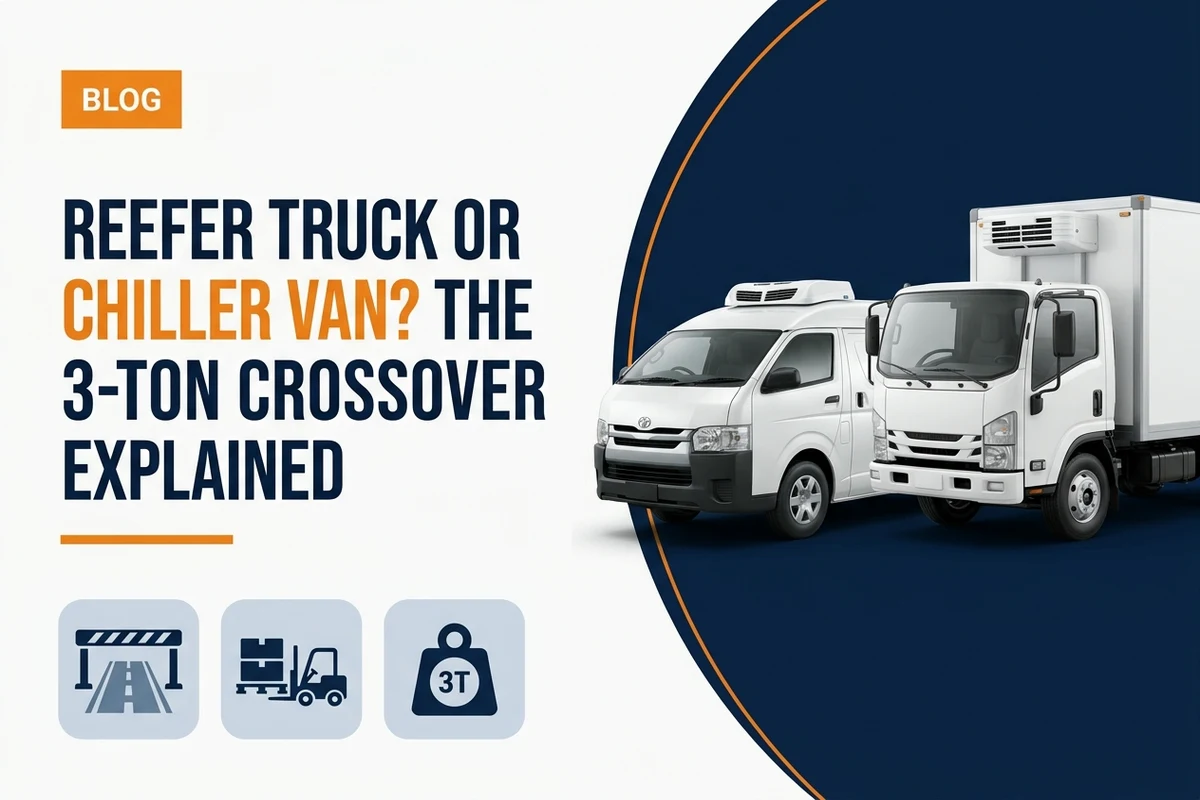
The received wisdom is that you move from a refrigerated van to a refrigerated truck at around three tons. It is roughly true and almost useless, because weight is the least important of the three things that actually decide it.
Most operators who switch do so for one of two reasons that have nothing to do with tonnage: their goods started arriving on pallets, or the body filled up while the suspension was barely working. Meanwhile plenty of businesses run 3-ton loads in vans quite sensibly, because their delivery points are places a truck cannot reach.
This is about working out which side of the line you are on, in the right order: access first, loading method second, weight last.
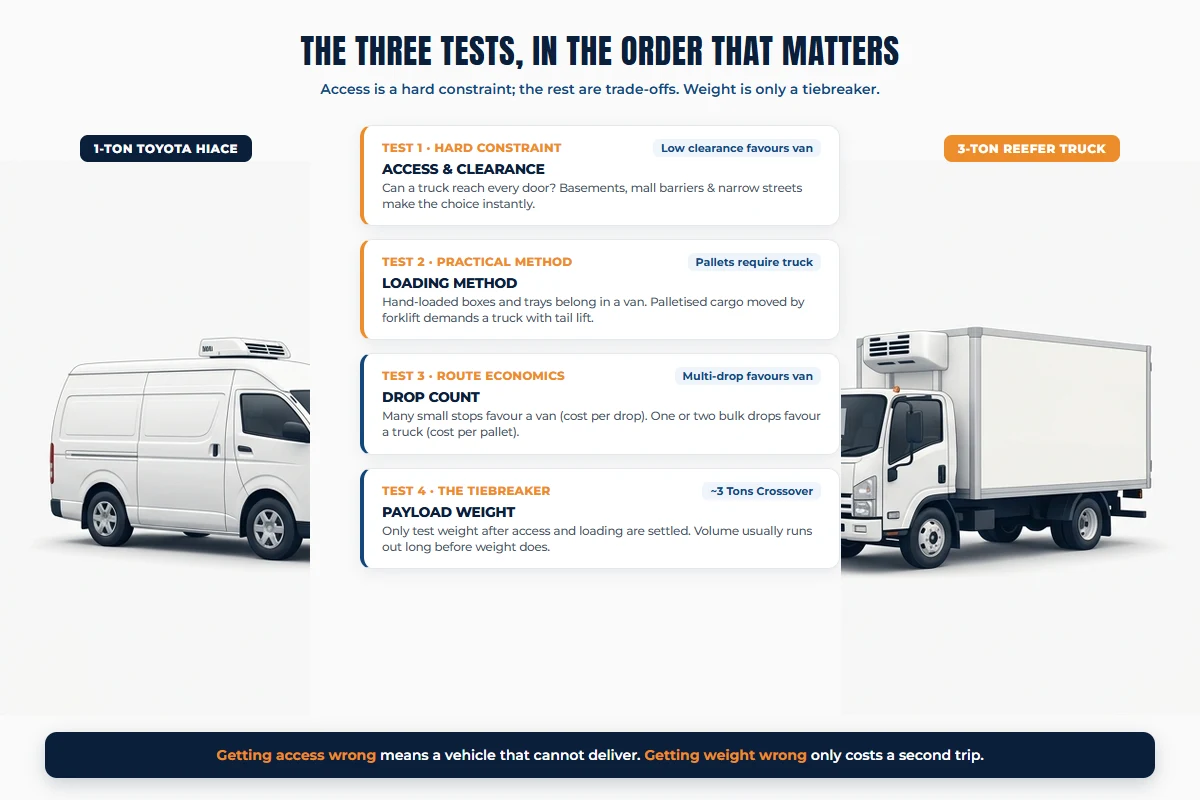
Test 1: Can a truck actually get there?
This is a yes-or-no question and it overrides everything below it. A truck that cannot reach the door does not save you money, because the cost of hand-carrying a load from wherever it had to stop will exceed any difference in hire rate within a couple of deliveries.
Work through your actual route and check for:
- Height-restricted entrances. Basement car parks, multi-storey service areas and some hotel and mall loading bays have barriers a truck will not clear.
- Turning space. A 3-ton box truck needs meaningfully more room to turn and reverse than a van. Older Deira streets, dense parts of Al Quoz and tight industrial yards can be impassable in practice even when they look fine on a map.
- Timed access windows. Many retail and hospitality sites restrict larger vehicles to specific hours. A van may be allowed through a window a truck is not.
- Where you can legally stop. On a multi-drop city route the van often parks close to the door while the truck ends up somewhere legal but distant.
Test 2: How do the goods move?
This is the test that decides most real cases, and it is the one people skip.
A refrigerated van of any size is a hand-loaded vehicle. Cargo goes in as crates, trays, boxes or roll cages through the rear and side doors. There is no tail lift, and the floor sits at a height a forklift cannot serve.
A refrigerated truck is a mechanically loaded vehicle. Its floor is at or near dock height, it usually has a tail lift, and its body is dimensioned so pallets fit the floor plan.
If your goods arrive on pallets and leave on pallets, the decision is already made. Even a modest palletised load belongs in a truck, because breaking pallets down to hand-load a van and rebuilding them at the other end costs labour and time on every single trip, and adds door-open minutes that work against your cargo.
| How your goods move | Vehicle | Why |
|---|---|---|
| Crates, trays, cartons by hand | Van | Side and rear door access, closer parking, lower rate |
| Roll cages or wheeled racks | Either — check the aperture | Rolls into a van only if the cage clears the door opening |
| Pallets, forklift at both ends | Truck | Dock-height floor and pallet-dimensioned body |
| Pallets, no dock at one end | Truck with a tail lift | The lift replaces the missing dock |
| Mixed: some pallets, some hand | Truck with a tail lift | Hand-loading into a truck is possible; forklifting into a van is not |
Worth noting the asymmetry in that last row. You can always hand-load a truck, awkwardly. You can never forklift a van. That makes the truck the more flexible vehicle and the van the more specialised one — which is the opposite of how most people think about it.
Test 3: How many drops?
Drop count is where the cost comparison actually lives, and it is why two businesses with identical tonnage can correctly choose different vehicles.
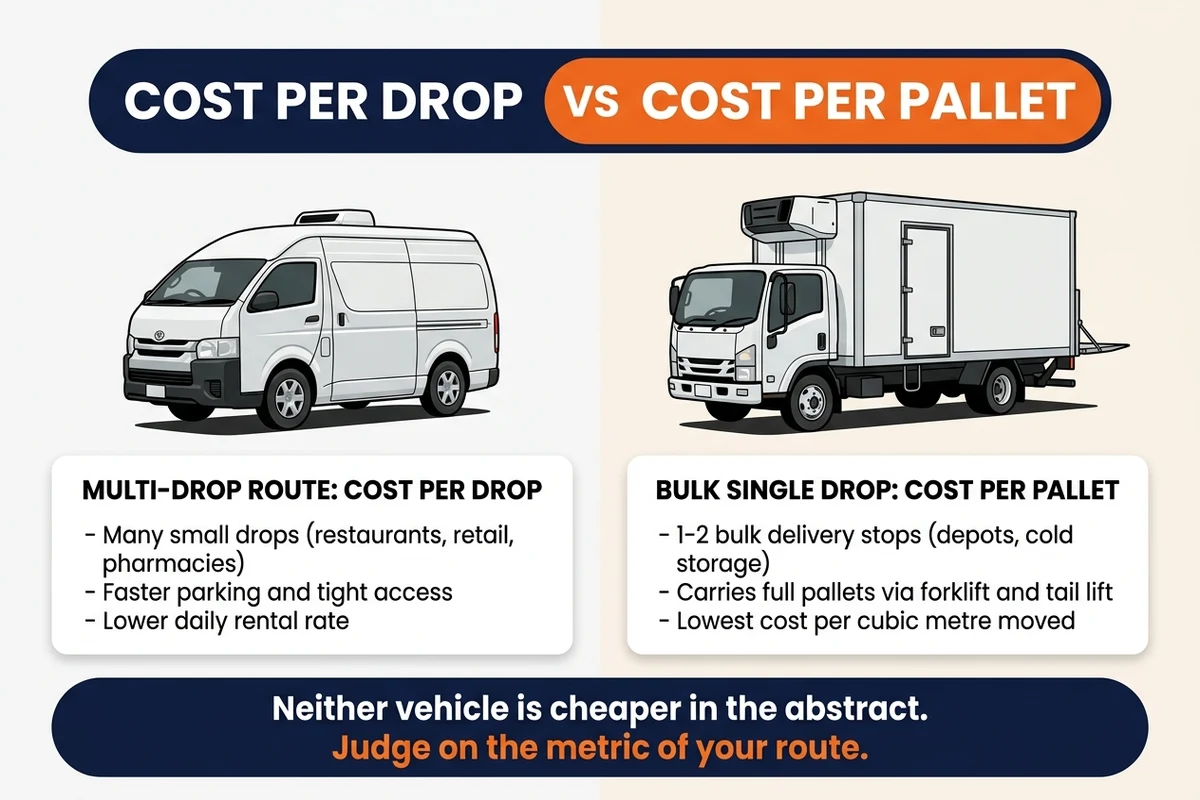
Many small drops. Twelve restaurants, eight pharmacies, fifteen retail units. Every stop costs time, and on this kind of route the van wins on almost every axis: it parks closer, it is quicker in and out, it is cheaper per day, and it is less likely to be turned away. The load is rarely heavy because it is split across many recipients.
One or two bulk drops. A central kitchen to a distribution centre, a factory to a wholesaler, a port collection to a cold store. Here the vehicle spends its day driving rather than stopping, the load travels as one consignment, and the truck moves several times the volume per trip.
The figure that matters flips between these two cases:
Test 4: Now look at the weight
If access allows a truck, your goods are hand-loaded, and you run a handful of drops, then weight becomes the tiebreaker — and around three tons is the honest crossover.
Two things are worth knowing about that figure.
Van payload runs out later than people expect. A 1-ton chiller van typically carries up to around 1.5 tons, and the class goes up from there. A 3-ton chiller van exists and is a genuine option, which is why the crossover is a zone rather than a line.
Volume usually runs out first anyway. On estimated figures, a standard 1-ton chiller body offers roughly 5 m³, of which about 4.4 m³ is usable once you allow for airflow. Most chilled cargo fills that long before it reaches the payload limit. If you are weighing up a bigger vehicle because the van keeps filling up, check whether the answer is a high roof body rather than a truck — it is a much smaller step in cost, licence and access.
Licence and driver
Easy to overlook and capable of derailing a hire entirely, particularly on self-drive.
A 1-ton chiller van sits within the standard UAE light vehicle licence, so your existing staff can generally drive it. A 3-ton truck usually requires a light or heavy truck category depending on gross vehicle weight.
This is a practical constraint rather than an administrative one. If nobody on your team holds the right category, moving to a truck means either hiring with a driver or getting someone licensed — and the first option changes your cost comparison substantially. Confirm the required category against the specific vehicle before you commit to a class of vehicle, not after.
Putting it together
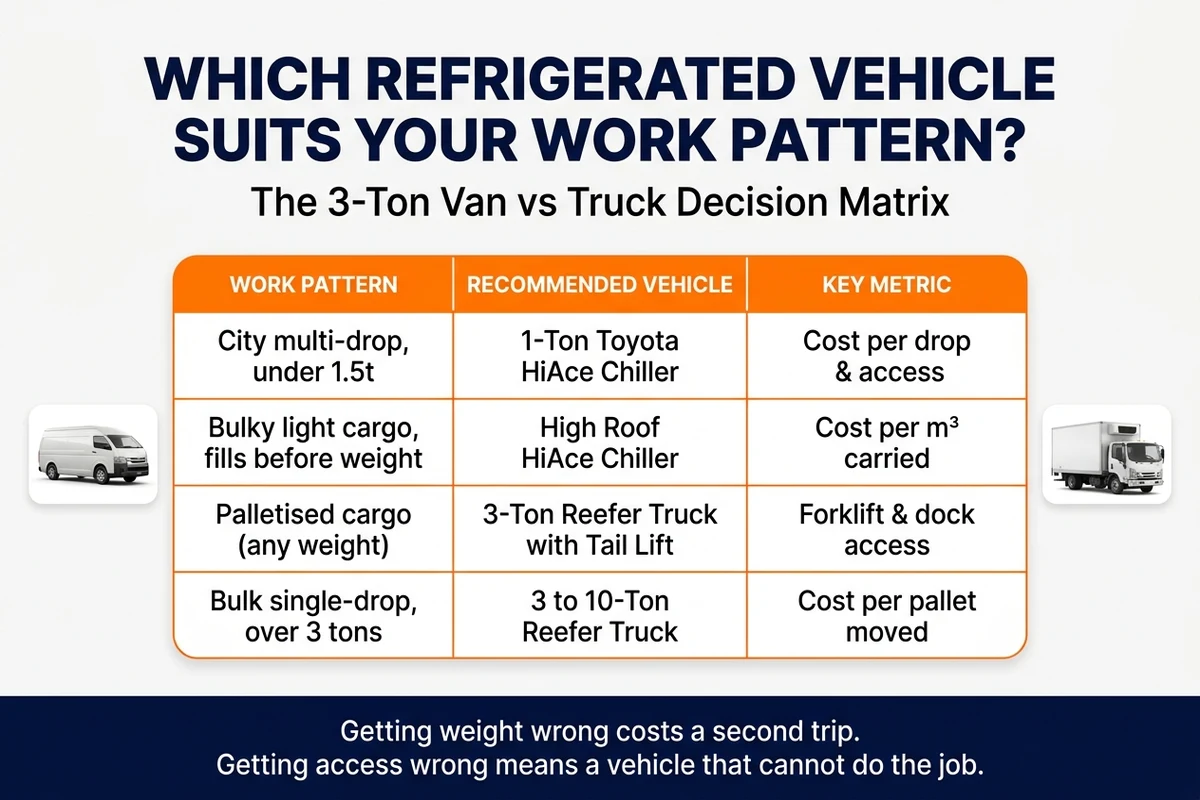
| Your pattern of work | Vehicle | Judge cost on |
|---|---|---|
| City multi-drop, hand-loaded, under ~1.5 t | 1-ton chiller van | Cost per drop |
| Body fills before the weight limit | High roof chiller van | Cost per m³ carried |
| Must stay frozen solid | Freezer van or freezer truck, by size | Whichever test above applies |
| Mid-size, hand-loaded, few drops, 1.5–3 t | 3-ton chiller van or small truck | Compare both — this is the zone |
| Palletised, any weight | Refrigerated truck with tail lift | Cost per pallet |
| Bulk single-drop, over ~3 t | 3 to 10 ton reefer truck | Cost per pallet |
| Chilled and frozen on one run | Dual-compartment body, van or truck | Whichever test above applies |
A note on what does not change
One assumption worth retiring: that a bigger vehicle holds temperature better.
It does not, inherently. A larger body contains more air to cool and has more surface area to lose heat through, and it is matched with a larger refrigeration unit to compensate. The things that actually decide whether cargo arrives in specification are the same in both: the body is pre-cooled before loading, the doors are kept shut between drops, and air can circulate around the load rather than short-circuiting over the top of it.
A well-run van beats a badly loaded truck on all three, every time. If you are considering a larger vehicle because loads have been arriving warm, it is worth checking the handover and loading discipline first — the problem is more often there than in the vehicle size. Our handover inspection checklist covers what to look for.
Where to go next
If you have landed on a van, chiller van rental covers the chilled range and refrigerated van rental covers both configurations. For sizing a body to a specific load, see chiller van internal dimensions.
If you have landed on a truck, refrigerated truck rental covers the 3 to 10 ton range, and freezer truck rental covers deep-freeze work. For vehicle specifications, compare the 3-ton reefer truck against the 1-ton Hiace chiller van — the two sides of the crossover.
If the honest answer is still “it depends on the week”, that is a legitimate position, and a mixed arrangement usually beats forcing every job into one vehicle class.
Frequently Asked Questions
- At what weight should I switch from a chiller van to a refrigerated truck?
- Around 3 tons, but weight is the least useful of the three tests. Most operators who move to a truck do so because their goods started arriving on pallets, or because the body filled before the weight did, not because they crossed a tonnage line. Work through loading method and drop count first; if both point at a van, a van is still right at 3 tons.
- Is a refrigerated truck cheaper than a van per delivery?
- Almost never per delivery, and often cheaper per pallet. A truck costs more per day and more per kilometre, so on a multi-drop route with small quantities at each stop a van wins comfortably. On a single-drop bulk run the truck moves far more per trip, so the cost of each pallet moved falls even though the daily rate rose.
- Can I fit pallets in a 3-ton chiller van?
- No, and this is the most common reason a hire goes wrong. A van of that class is hand-loaded through rear and side doors with no tail lift and no forklift access. A pallet footprint may sit on the floor, but nothing can place it there mechanically. If your goods arrive and leave palletised you need a truck with a tail lift, whatever the weight is.
- What is a tail lift and do I need one?
- A powered platform at the rear of a truck that raises a load from ground level to floor height. You need one if goods move on pallets or roll cages and the collection or delivery point has no dock. If both ends of your route have a loading dock at truck-bed height, a truck without a tail lift is cheaper and loads faster.
- Do I need a different licence to drive a 3-ton refrigerated truck in the UAE?
- Usually yes. A 1-ton chiller van sits inside the standard UAE light vehicle licence, while a 3-ton truck generally requires a light or heavy truck category depending on gross vehicle weight. Confirm the category against the specific vehicle before you plan a self-drive hire, because it decides whether your existing staff can drive it at all.
- Will a refrigerated truck reach my delivery points?
- That is the question to ask before any of the cost arithmetic. Basement car parks, older city streets, timed-access mall bays and narrow service entrances all favour a van. A truck that cannot reach the door turns a delivery into a hand-carry, and the labour cost of that will dwarf the difference in hire rate.
- Can one vehicle carry both chilled and frozen cargo?
- Yes, on a dual-compartment body, where an insulated bulkhead splits the cargo area into two zones with separate set points. It is available in both van and truck sizes. Specify it at quote stage, because dual-compartment vehicles are a subset of any fleet.
- Is a bigger vehicle better at holding temperature?
- Not inherently. A larger body has more air to cool and more surface area to lose heat through, and it is matched with a larger unit to compensate. What actually decides arrival temperature is pre-cooling, door discipline and airflow around the load — and a well-run van beats a badly loaded truck on all three.
Not sure which side of the line you are on?
Send us the load weight, the number of drops and how the goods are packaged. We run both vans and trucks, so there is no answer we are steering you toward — and if a van is cheaper for your route we would rather tell you that now than after a month of hire.